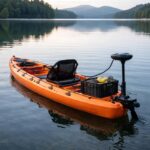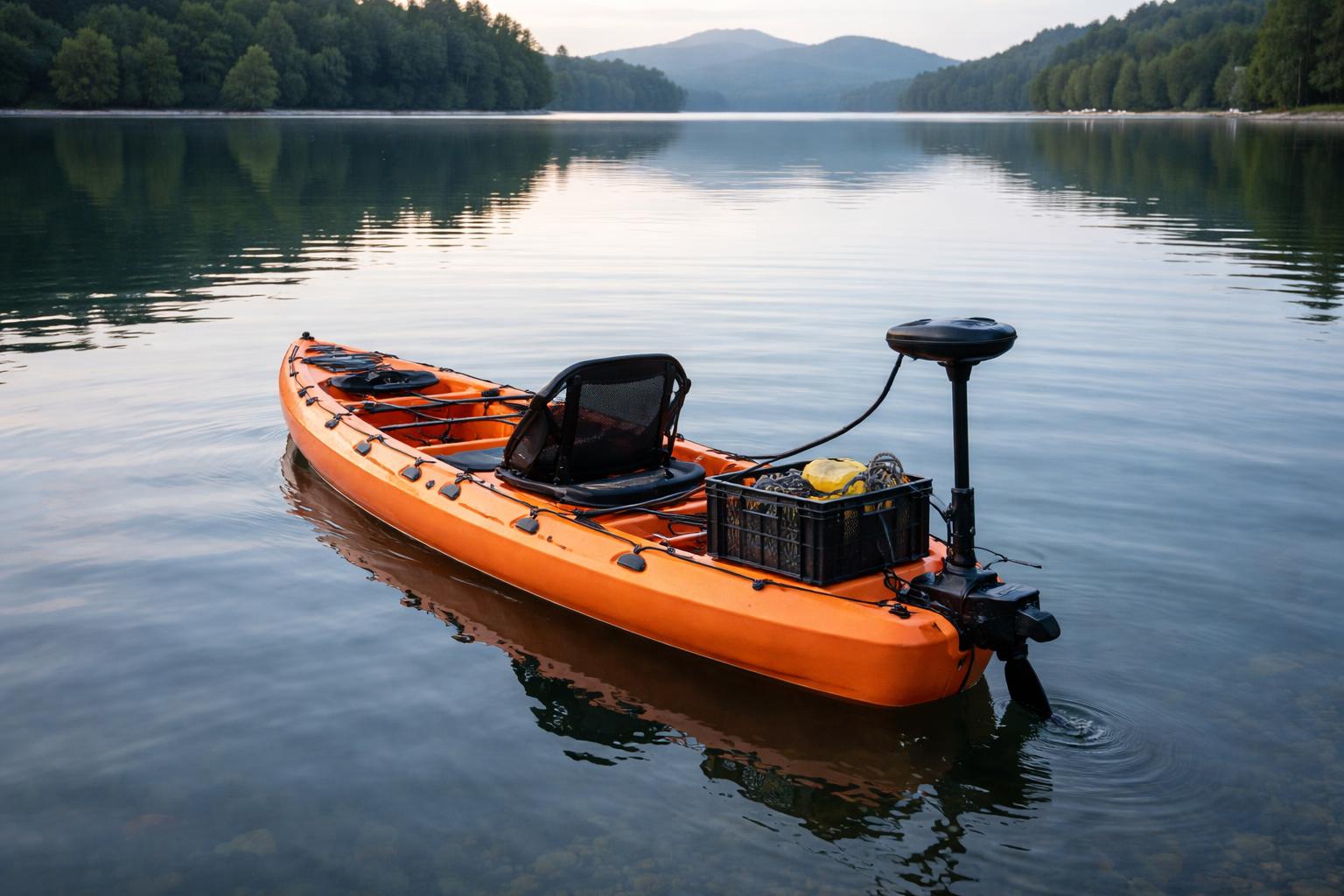
Choosing the right kayak trolling motor can be the difference between spending your day fighting wind and current and spending more time exactly where the fish are. The best motor gives you enough thrust to move your fully loaded kayak confidently, without adding unnecessary weight, battery bulk, or complexity to your setup.
For most kayak anglers, the Minn Kota Endura C2 30 is our top all-around pick because it offers a strong balance of thrust, reliability, manageable weight, and straightforward transom mounting. If you’re running a larger or heavily loaded kayak, the MotorGuide R3-45 provides more pushing power, while the Bixpy J-2 stands out for pedal-drive kayaks and anglers who want a lightweight, portable system.
But choosing a motor isn’t simply about buying the one with the highest thrust rating. You also need to consider your kayak’s fully loaded weight, battery capacity, motor weight, mounting system, water conditions, and whether you’ll fish in freshwater or saltwater. A motor that’s perfect for a lightweight fishing kayak can be completely wrong for a heavily rigged tandem.
In this guide, we’ve compared seven of the best kayak trolling motors for 2026 and broken down their thrust, weight, mounting options, battery requirements, strengths, weaknesses, and ideal use cases. You’ll also find a practical thrust guide, battery-sizing advice, installation tips, maintenance recommendations, and safety considerations so you can choose a motor that actually fits your kayak and the way you fish.
Quick answer: The best all-around kayak trolling motor for most anglers is the Minn Kota Endura C2 30 quiet, durable, and easy to mount on almost any fishing kayak. If you need more power for a larger kayak or windy water, step up to the MotorGuide R3-45. If your kayak has a pedal drive well or you want an ultralight setup you can move between boats, the Bixpy J-2 is the top pick. Full breakdowns, specs, and buying advice are below.
Don’t skip this learn how to store a kayak in winter the right way before the first freeze hits.
Introduction to Kayak Trolling Motors
Personal Experience: Navigating the Waters
Over a decade ago, I found myself battling relentless headwinds on a sprawling lake, exhausting myself before even reaching my preferred fishing spot. That day, the revelation hit me: a kayak trolling motor wasn’t just a luxury it was a necessity for serious kayak fishing. Since then, I’ve personally tested countless electric motor options, from compact designs for smaller kayaks to powerful units capable of transforming a fishing kayak into a formidable motorized kayak.
Why Choose a Kayak Motor for Fishing?
For any dedicated kayak angler, adding a motor to their setup can revolutionize their approach to fishing. A kayak motor lets you cover more water efficiently, conserve energy for actual fishing, and quickly reposition when targeting elusive species. That mobility opens up remote fishing spots that would otherwise be unreachable.
The Benefits of Kayak Trolling
Kayak trolling with an electric motor allows for precise speed control crucial for effective bait presentation while cutting the physical exertion of long-distance paddling. You can hold a consistent pace so your lures work properly, and get the quiet approach needed to sneak up on wary fish without spooking them.
Ready to get organized? Browse the best kayak fishing crates and never dig through a tackle mess again.
At-a-Glance: Best Kayak Trolling Motors 2026
| Motor | Best For | Thrust | Weight | Mount Type | Price Range* |
|---|---|---|---|---|---|
| Minn Kota Endura C2 30 | Best Overall | 30 lb | 17 lb | Transom | $150–$200 |
| Newport Vessels Kayak Series 36 | Best Budget Pick | 36 lb | ~19 lb | Transom (kayak-specific) | $150–$180 |
| MotorGuide R3-45 | Best for Larger Kayaks | 45 lb | ~23 lb | Transom | $200–$230 |
| Haswing Cayman B 55 | Best Bow Mount / Wireless | 55 lb | 34 lb | Bow mount | $300–$400 |
| Bixpy J-2 Motor Kit | Best Portable / Pedal-Kayak | 33 lb continuous (48 lb peak) | ~9–10 lb (motor + battery) | Universal fin/rudder adapter | $1,100–$1,400+ |
| Newport Vessels Kayak Series 55 | Best Step-Up for Bigger Loads | 55 lb | ~24 lb | Transom (kayak-specific) | $200–$260 |
| Watersnake ASP T18 | Best Ultra-Compact / Saltwater | 18 lb | 4.85 lb | Transom (kayak bracket) | $100–$150 |
Best Overall + Best For Recommendations
- Best Overall: Minn Kota Endura C2 30 the safest pick if you only want to buy one motor and never think about it again.
- Best Budget Buy: Newport Vessels Kayak Series 36 the cheapest motor on this list that’s actually built for kayaks, not adapted from a boat product line.
- Best for Larger or Loaded Kayaks: MotorGuide R3-45 enough thrust to push a fully rigged 12–14 ft fishing kayak against light current or wind.
- Best Bow Mount: Haswing Cayman B 55 wireless remote and bow placement give you hands-free steering while you fish.
- Best for Pedal Kayaks & Portability: Bixpy J-2 swaps between multiple kayaks, canoes, or paddleboards using different adapters; the lightest true motor system here.
- Best Step-Up Option: Newport Vessels Kayak Series 55 same kayak-specific design as the budget pick, with more muscle for bigger boats.
- Best Ultra-Compact / Saltwater: Watersnake ASP T18 smallest, lightest option, purpose-built saltwater components, ideal for solo anglers in calm coastal water.
How We Tested and Selected These Motors
Evaluation Criteria for the Best Kayak Motors
Selecting the best kayak trolling motor takes more than looking at a price tag. Our selection criteria focused on real-world performance for the kayak angler: sustained thrust output, practical battery life, and build quality. We also checked how easily each motor integrates with different kayak types, making sure mount options were versatile enough for a fishing kayak setup.
Understanding Specifications: Thrust and Battery Life
Thrust in pounds tells you how much power the motor can generate directly tied to its ability to push your kayak against current or wind. Battery amp-hours (Ah) tell you how long it can sustain that output. We weighed both, since a motor with big thrust but a small battery can leave you stranded.
Noise Levels and Weight Considerations
For stealthy kayak fishing, low noise matters as much as power. We also weighed each motor’s actual weight, since a heavy motor changes your kayak’s balance and makes transport harder especially if you’re solo-launching from a roof rack or truck bed.
Our Ranking Methodology
Every motor on this list was scored across five weighted categories, for a maximum of 100 points. This scoring reflects what actually matters for kayak not boat use, which is why thrust-per-dollar is weighted lower than practical factors like weight and mount versatility.
| Category | Weight | What We Looked At |
|---|---|---|
| Power & Thrust Efficiency | 25% | Thrust output relative to weight and amp draw |
| Build Quality & Durability | 20% | Materials, shaft construction, brand reliability history |
| Weight & Portability | 20% | Total carry weight, ease of solo transport and launch |
| Mounting Versatility | 15% | Compatibility with common kayak transom/bow/pedal setups |
| Value for Price | 20% | Feature set and durability relative to typical street price |
A motor’s final “Best For” label (Best Overall, Best Budget, Best Bow Mount, etc.) reflects which category it scored highest in relative to the rest of the field, not necessarily the highest total score a $100 ultra-compact motor isn’t competing on the same axis as a $1,300 pedal-kayak system, so we ranked each for its intended use case rather than forcing every motor into a single overall ranking.
Stop drifting off your spot master how to anchor a kayak and lock in on the fish.
How Much Thrust Do You Actually Need? (Thrust Guide)
Thrust requirements scale with your kayak’s fully loaded weight (kayak + gear + angler), not just the kayak’s empty weight. A commonly used rule of thumb in the trolling motor industry:
~2 lbs of thrust per 100 lbs of fully loaded weight, for calm water with minimal current or wind.
| Fully Loaded Kayak Weight | Minimum Recommended Thrust | Comfortable Thrust (wind/current) |
|---|---|---|
| 250–350 lb (solo, lightly loaded) | 18–24 lb | 30–36 lb |
| 350–450 lb (solo + full gear) | 30–36 lb | 40–45 lb |
| 450–600 lb (tandem or heavily rigged) | 45–55 lb | 55–70 lb |
| 600+ lb (large tandem, motorized console) | 55–70 lb | 70+ lb |
Notes:
- Add 10–20% more thrust if you regularly fish rivers with current, open bays with wind chop, or saltwater with tidal flow.
- Bow-mounted motors generally need slightly less thrust than transom-mounted motors for the same kayak, because they push from the front rather than fighting the kayak’s tendency to weathervane.
- More thrust always draws more amps which shortens your runtime unless you upsize the battery to match.
Getting to the water shouldn’t be the hard part see the easiest ways how to transport a kayak today.
Complete Battery Guide for Kayak Trolling Motors
12V Systems and Amp-Hours (Ah)
The vast majority of kayak trolling motors run on a single 12-volt deep-cycle battery. Battery capacity is measured in amp-hours (Ah) the higher the number, the longer your runtime at a given power draw.
Rough runtime formula: Runtime (hours) ≈ Battery Ah ÷ Motor Amp Draw at your chosen speed
Example: A 50Ah battery paired with a motor drawing 10 amps at cruising speed gives you roughly 5 hours of runtime (in practice, expect somewhat less due to voltage sag and battery efficiency losses).
Lithium vs. Lead-Acid
| Factor | Lead-Acid (AGM/Deep Cycle) | Lithium (LiFePO4) |
|---|---|---|
| Upfront cost | Lower ($80–$150 for 50–100Ah) | Higher ($300–$600+ for similar Ah) |
| Weight | Heavy (35–65 lb for 50–100Ah) | Light (10–20 lb for same Ah) |
| Usable capacity | ~50% of rated Ah (avoid deep discharge) | ~80–100% of rated Ah |
| Lifespan | 300–500 charge cycles | 2,000–5,000+ charge cycles |
| Charging speed | Slower | Faster |
| Best for | Budget-conscious anglers, occasional use | Frequent anglers, weight-sensitive kayaks |
Runtime, Weight, and Charging Tips
- A 50–75Ah lead-acid battery is the most common starting point for 30–45 lb thrust motors and will typically deliver 2–5 hours of mixed-speed use.
- Lithium batteries are worth the extra cost if you fish full days, since their higher usable capacity and lighter weight directly improve both range and kayak stability.
- Always fully charge before each trip, and avoid draining lead-acid batteries below 50% charge to protect their lifespan.
- Store batteries in a dry hatch or a dedicated waterproof battery box corrosion from bilge water is one of the most common causes of premature battery failure on kayaks.
Stop fishing blind check out the best fish finders for kayak anglers and see exactly where they’re biting.
Top 7 Kayak Trolling Motors for 2026
1. Minn Kota Endura C2 30 Best Overall for Freshwater Kayak Fishing
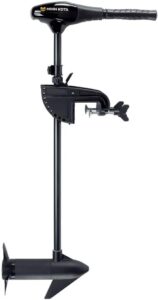
The Minn Kota Endura C2 30 is a true workhorse, known for exceptional durability and consistent performance in freshwater. It’s the motor most kayak anglers should default to unless they have a specific reason to go bigger or smaller.
Best for: Freshwater lakes, ponds, and slow-moving rivers on a solo or lightly loaded fishing kayak. Who should buy: Anglers who want a proven, no-drama motor backed by one of the most trusted names in the industry. Who should avoid: Anyone with a heavily loaded tandem kayak or who regularly fights strong current 30 lb thrust will feel underpowered.
Battery & mounting: Runs on a single 12V deep-cycle battery (50Ah+ recommended). Mounts via a transom clamp; works with most aftermarket kayak transom brackets if your kayak doesn’t have a built-in transom.
Specs
| Spec | Detail |
|---|---|
| Thrust | 30 lb |
| Voltage | 12V |
| Shaft | Composite, lifetime guaranteed |
| Speeds | 5 forward / 3 reverse |
| Weight | ~17 lb |
| Amp draw (max) | 30A |
Pros & Cons
| Pros | Cons |
|---|---|
| Legendary Minn Kota reliability | Only 30 lb thrust low for larger kayaks |
| Quiet operation | No digital maximizer |
| Indestructible composite shaft | Basic feature set |
| Widely available, easy to service | Telescoping handle only (no wireless remote) |
Our Verdict: If you only take one recommendation from this guide, make it this one. The Endura C2 30 does everything most kayak anglers need without asking you to think about it that reliability is exactly why it earns Best Overall.

- Telescoping Tiller: This 6-inch telescoping tiller provides easy, comfortable, and intuitive control of your trolling mo…
- 10-Position Lever Lock Bracket: Easy-release lever lock system lets you quickly adjust and secure your trolling motor an…
- Power Prop for Heavy Vegetation: Designed for 3-1/4″ motor diameters, this high-performance propeller delivers extra thr…
2. Newport Vessels Kayak Series 36 lb Thrust Best Budget Pick
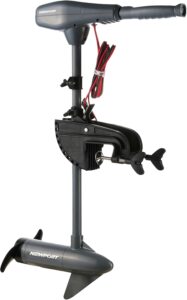
Unlike generic transom motors adapted from boats, the Newport Vessels Kayak Series was purpose-built for kayak anglers, with an adjustable 24-inch shaft and extended battery cabling designed around kayak transoms.
Best for: Budget-conscious anglers fishing calm lakes, ponds, or slow rivers from a smaller fishing kayak. Who should buy: First-time motor buyers who want a genuinely kayak-specific design without paying premium prices. Who should avoid: Anglers who need strong thrust for wind, current, or a heavier tandem kayak.
Battery & mounting: Powered by one 12V lead-acid deep-cycle or marine battery. Transom mount with extended cabling made specifically for kayak battery placement.
Specs
| Spec | Detail |
|---|---|
| Thrust | 36 lb |
| Voltage | 12V |
| Shaft | 24″ (height-adjustable) |
| Speeds | 5 forward / 3 reverse |
| Weight | ~19 lb |
| Battery indicator | 5-LED |
Pros & Cons
| Pros | Cons |
|---|---|
| Purpose-built for kayaks, not adapted from boats | Limited thrust for strong currents |
| Affordable | Brushed motor design |
| Simple to install | Shorter shaft may not suit high-freeboard kayaks |
| 2-year warranty | Basic tiller control only |
Our Verdict: The closest thing to a “sure thing” at this price point. It won’t wow you with features, but it’s genuinely built for kayaks rather than repurposed from a boat lineup a rare thing at this price.

- Kayak Shaft: 24-Inch Fiberglass Shaft Allows For Variable Depth Placement, While Offering A Lifetime Of Dependable Perfo…
- Variable Speed: 8 Speeds (5 Forward & 3 Reverse) With 6-Inch Telescoping Handle Puts You In Total Control Of Your Ride
- Saltwater Rated: Durable All Aluminum Motor Head W/ Corrosion Resistant Magnesium, Zinc, And Stainless-Steel Hardware Fo…
3. MotorGuide R3-45 Best for Larger Kayaks and Varied Conditions
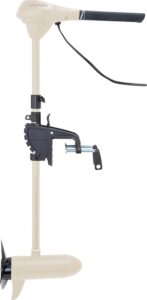
The MotorGuide R3-45 delivers noticeably more push than the entry-level options, making it a strong choice for anglers who need extra control in wind or light current without jumping to a premium bow-mount system.
Best for: Larger or heavily rigged fishing kayaks, and anglers who regularly deal with wind or mild current. Who should buy: Kayak anglers who’ve outgrown a 30 lb thrust motor but don’t need or want to pay for a bow-mount wireless system. Who should avoid: Minimalists who prioritize the lightest possible setup; this motor is noticeably heavier than the budget picks.
Battery & mounting: Runs on a single 12V deep-cycle battery (75Ah+ recommended for extended use at higher thrust). Transom mount with a multi-position tilt/stow bracket.
Specs
| Spec | Detail |
|---|---|
| Thrust | 45 lb |
| Voltage | 12V |
| Shaft | 36″ |
| Speeds | 5 forward / 2 reverse |
| Weight | ~23 lb |
| Prop | 3-blade |
Pros & Cons
| Pros | Cons |
|---|---|
| Higher thrust for larger kayaks | Heavier than budget/entry motors |
| Solid aluminum alloy construction | 12V system means higher amp draw at full power |
| Ergonomic extending handle | Propeller can snag heavy weeds |
| Good value for the power delivered | No wireless remote |
Our Verdict: The sweet spot for anglers who’ve outgrown a 30 lb motor. It costs more and weighs more, but the extra thrust genuinely pays off the first time you fight wind on open water.

- 45 pounds peak thrust rating with 12-volt power
- 36″ fiberglass shaft
- Variable speed with extended twist-tiller steering
4. Haswing Cayman B 55 lb Best Bow Mount for Hands-Free Control
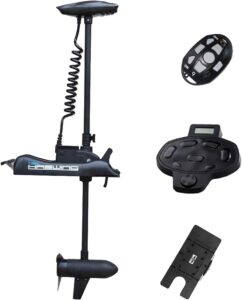
The Haswing Cayman B is a genuine step up in capability: a bow-mounted, wireless-remote-controlled motor that turns a traditional fishing kayak into something close to a small bass boat in terms of maneuverability.
Best for: Advanced kayak anglers who want hands-free, front-mounted steering for techniques like sight fishing or working tight cover. Who should buy: Anglers with a kayak that can structurally support a bow mount, and who value precise positioning over raw simplicity. Who should avoid: Anyone whose kayak lacks a suitable bow-mounting point, or who wants a simple plug-and-go setup.
Battery & mounting: 12V deep-cycle battery (75–100Ah recommended given the higher thrust draw). Bow mount with a corrosion-resistant aluminum shaft; suitable for both fresh and saltwater.
Specs
| Spec | Detail |
|---|---|
| Thrust | 55 lb |
| Voltage | 12V |
| Shaft | 48″ |
| Control | Wireless remote (164 ft range) |
| Weight | 34 lb |
| Rating | 4.3★ (100+ reviews) |
Pros & Cons
| Pros | Cons |
|---|---|
| Wireless remote for hands-free control | Heaviest motor on this list |
| Strong 55 lb thrust | Requires a kayak with a viable bow-mount point |
| Freshwater and saltwater rated | Pricier than transom-mount options |
| Whisper-quiet operation | Larger battery recommended, adding cost/weight |
Our Verdict: Worth the jump in price and weight only if your kayak can actually support a bow mount but if it can, the hands-free control changes how you fish, not just how you move.

- Haswing Cayman 48 INCH Shaft Bow Mount Trolling Motor is designed and engineered to run quieter than ever before. It’s s…
- The 2.4G wireless remote control fits into the palm of your hand easily or can be attached around your neck with a lanya…
- Cruise control (NOT Spot lock) keeps your boat at the desired speed by using remote control to press on the speed up or …
5. Bixpy J-2 Motor Kit Best Portable, Multi-Kayak Solution
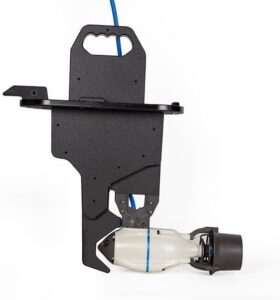
The Bixpy J-2 takes a completely different approach: a compact jet-drive motor paired with a dedicated lithium battery, designed to move between kayaks, canoes, and paddleboards using swappable adapters. It’s the go-to choice for owners of pedal-drive kayaks who want to add power without ripping out their pedal system.
Best for: Anglers who own a pedal-drive kayak (or multiple watercraft) and want an ultralight, easily transferable motor. Who should buy: Anyone prioritizing portability and weight savings above all else, or who wants to power more than one kayak/board with a single unit. Who should avoid: Budget-focused buyers this is the most expensive option here by a wide margin.
Battery & mounting: Comes as a complete kit with its own waterproof lithium battery (378Wh, 25.2V) no separate marine battery needed. Mounts via kayak-specific adapters into an existing fin box, rudder mount, or transom bracket depending on your kayak model.
Specs
| Spec | Detail |
|---|---|
| Thrust | 33 lb continuous / 48 lb peak |
| Battery | 378Wh lithium-ion (included) |
| Runtime | ~80 min at top speed, up to 12 hrs at low speed |
| Speeds | 12 forward / 3 reverse (wireless remote) |
| Weight | ~9–10 lb (motor + battery combined) |
Pros & Cons
| Pros | Cons |
|---|---|
| Extremely lightweight and portable | Highest price point on this list |
| Battery included no separate marine battery needed | Requires model-specific adapter for your kayak |
| Excellent for pedal-drive kayaks | Shorter max runtime than lead-acid setups at full power |
| Swappable between multiple watercraft | Replacement adapters and rudder kits add extra cost |
Our Verdict: Expensive, but it’s solving a different problem than every other motor on this list if you own a pedal kayak or multiple boats, nothing else here comes close to its convenience.

- COMPATIBLE WITH BIXPY J-2 MOTORS – Designed to integrate a Bixpy J-2 motor with compatible BOTE inflatable kayaks using …
- NO-DRILL MOUNTING SOLUTION – Replaces the pedal drive assembly without requiring permanent modifications, helping mainta…
- STARBOARD MATERIAL CONSTRUCTION – Manufactured from waterproof Starboard material designed for use in marine environment…
6. Newport Vessels Kayak Series 55 lb Best Step-Up for Bigger Loads
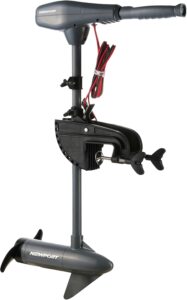
If the 36 lb Newport Kayak Series isn’t enough but you still want a motor purpose-built for kayaks rather than adapted from a boat, the 55 lb version in the same line is the natural upgrade.
Best for: Anglers with a larger solo kayak or a lightly loaded tandem who want more push than the entry-level Kayak Series offers. Who should buy: Anyone who liked the simplicity of the 36 lb Newport but needs more muscle for bigger water or a heavier boat. Who should avoid: Anglers who want a bow-mount or wireless system this is still a straightforward transom design.
Battery & mounting: Single 12V deep-cycle battery (75Ah+ recommended). Kayak-specific transom mount with the extended cabling found across the Newport Kayak Series line.
Specs
| Spec | Detail |
|---|---|
| Thrust | 55 lb |
| Voltage | 12V |
| Shaft | 24″ (adjustable) |
| Speeds | 5 forward / 3 reverse |
| Weight | ~24 lb |
| Battery indicator | 5-LED |
Pros & Cons
| Pros | Cons |
|---|---|
| Purpose-built kayak transom design | Heavier than the 36 lb version |
| More thrust for bigger or loaded kayaks | Still lead-acid battery only |
| Same trusted, affordable product line | Basic tiller control, no remote |
| 2-year warranty | Shorter shaft may limit some kayak setups |
Our Verdict: A smart middle path you keep the simplicity of a kayak-specific transom motor while getting real power for a bigger boat, without paying bow-mount prices.
- COMPATIBLE WITH BIXPY J-2 MOTORS – Designed to integrate a Bixpy J-2 motor with compatible BOTE inflatable kayaks using …
- NO-DRILL MOUNTING SOLUTION – Replaces the pedal drive assembly without requiring permanent modifications, helping mainta…
- STARBOARD MATERIAL CONSTRUCTION – Manufactured from waterproof Starboard material designed for use in marine environment…
7. Watersnake ASP T18 Best Ultra-Compact, Saltwater-Ready Motor
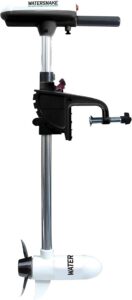
The Watersnake ASP T18 is the smallest, lightest motor on this list, built specifically for kayaks and small canoes with a dedicated kayak mounting bracket.
Best for: Solo anglers fishing calm coastal water, estuaries, or tidal creeks who prioritize minimal weight above all else. Who should buy: Anglers who want the lightest possible setup and don’t need serious thrust. Who should avoid: Anyone fishing larger kayaks, strong current, or open water with wind chop 18 lb thrust is genuinely limited.
Battery & mounting: Runs on a small 12V deep-cycle battery (even a compact 35Ah unit is sufficient given the low amp draw). Uses a dedicated Watersnake kayak bracket for transom-style attachment.
Specs
| Spec | Detail |
|---|---|
| Thrust | 18 lb |
| Voltage | 12V |
| Shaft | 24″ |
| Speeds | 2 forward / 2 reverse |
| Weight | 4.85 lb |
| Rating | 4.1★ (1,400+ reviews) |
Pros & Cons
| Pros | Cons |
|---|---|
| Lightest motor on this list by far | Low thrust best for very small kayaks and calm water |
| Purpose-built kayak bracket included | Basic 2-speed control only |
| Affordable | Short shaft may not suit all kayaks |
| Saltwater-rated components | Limited power reserve for wind or current |
Our Verdict: Don’t underestimate this one just because it’s small for the right use case (light kayak, calm water, saltwater exposure), it’s genuinely the smartest buy on this list.
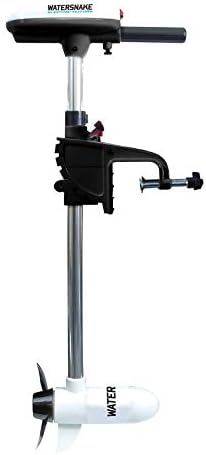
- PORTABLE – Watersnake Saltwater Electric Outboard Motor is the ultimate in lightweight portability, weighing only 4.85lb…
- COMPATIBLE – It is the ideal trolling motor to use on kayaks, canoes, small dinghies, and inflatable boats. Please note:…
- DESIGN – 24” shaft, adjustable mount fitting that makes for easy attachment, and anti-impact clip system. This easy to s…
Can You Put a Trolling Motor on Any Kayak?
Not quite but most fishing-focused kayaks can be motorized with the right setup. Here’s what actually determines compatibility:
- Hull design: Wider, more stable kayaks (typically 30″+ beam) handle a motor’s added weight and torque far better than narrow touring kayaks, which can become tippy.
- Weight capacity: Your kayak needs enough spare capacity to carry the motor, battery, and mounting hardware often an added 25–50 lb without exceeding its rated limit.
- Transom or mounting point: Many fishing kayaks now ship with a built-in transom or accessory rails designed for motor mounts. Kayaks without one usually need an aftermarket universal transom bracket.
- Material: Rigid hard-shell kayaks (polyethylene, composite) are the easiest to motorize. Inflatable kayaks can work too, but only with reinforced transom plates rated for motor use check the manufacturer’s specs before assuming it’ll hold.
- Hull shape underneath: A flatter, more stable hull tolerates a rear-mounted motor’s weight better than a rounded touring hull, which can squat or become unbalanced.
Bottom line: If your kayak is a dedicated fishing kayak (10 ft+, wide and stable, rated for 350+ lb capacity), it’s very likely motor-compatible. Narrow recreational or touring kayaks are the ones to double-check carefully or avoid motorizing altogether.
Hands-free fishing starts here explore the best pedal kayaks for fishing and upgrade your next trip.
How to Mount a Trolling Motor on a Kayak
The exact steps vary by motor and kayak model, but the general process looks like this:
- Confirm your mounting point. Check whether your kayak has a built-in transom, accessory rail, or requires a separate universal transom bracket (most non-fishing-specific kayaks will need one).
- Install the mounting bracket. Attach the bracket per the manufacturer’s instructions this usually involves clamping or bolting it to the transom or rail system. Make sure it’s centered and level so the motor pushes straight, not at an angle.
- Attach the motor to the bracket. Slide or clamp the motor’s shaft into the mount, then set your desired depth so the propeller is fully submerged but not scraping bottom in shallow water.
- Route and connect the battery cables. Run the cables to your battery compartment (usually in a hatch or dry storage area), keeping connections away from splash zones where possible. Use zip ties or cable clips to prevent cables from dragging in the water or catching on gear.
- Secure the battery. Place the battery in a stable, low position (for balance) inside a hatch or a dedicated waterproof battery box, and strap it down so it can’t shift while you’re on the water.
- Test on land first. Before launching, power on the motor and run through forward, reverse, and speed settings to confirm everything responds correctly and nothing rattles loose.
- Do a short test paddle-out. On your first trip, test the motor in calm, shallow water close to shore before heading out further, so you can catch any mounting or wiring issues early.
Pro tip: Loctite or thread-lock compound on mounting bolts helps prevent them from vibrating loose over repeated trips a small step that saves you from losing hardware (or the motor) on the water.
Turn your kayak into a fishing machine: see our favorite kayak fishing rigging setups anglers swear by.
Kayak Trolling Motor Maintenance
A little upkeep goes a long way toward extending the life of your motor:
- Rinse after every trip especially in saltwater. Flush the shaft, propeller, and lower unit with fresh water to prevent corrosion and salt buildup.
- Inspect the propeller regularly for fishing line, weeds, or debris wrapped around the shaft, which can strain the motor and cause overheating.
- Check mounting hardware each trip for loose bolts, clamps, or brackets vibration from motor use loosens fasteners over time.
- Store batteries properly keep lead-acid batteries charged above 50% during storage, and store lithium batteries at roughly 50% charge if not using them for extended periods.
- Dry and store the motor indoors when possible, away from prolonged UV exposure and freezing temperatures, both of which degrade seals and plastic components over time.
- Check brushes and seals annually (or per the manufacturer’s schedule) on brushed motors worn brushes are a common cause of gradual power loss.
- Keep an eye on cable connections for corrosion or fraying, especially at the battery terminals, and clean them with a wire brush and dielectric grease as needed.
Kayak Motor Buying Guide: Choosing the Best Trolling Motor for Your Kayak
Picking a motor for a kayak is a different exercise than picking one for a bass boat weight, balance, and mount compatibility matter far more. Among the best fishing kayak motors and general fishing kayak motors we evaluated for this guide, thrust-to-weight ratio was consistently the biggest differentiator, more than raw price. Once you line up what each motor offers against what it costs, the right choice usually becomes obvious.
Motor Buying Basics: Where to Start
Good motor buying starts with three questions: what type of kayak do you have, what’s your budget, and how much thrust does your setup actually need (see the Thrust Guide above)? Skipping this step in the motor buying guide process is the most common reason anglers end up returning a motor that’s either underpowered or too heavy for their kayak.
Types of Kayak Motors: Transom, Bow Mount Motor, and Pedal-Integrated Kits
Kayak motors generally fall into a handful of types of kayak motors, and the right type of kayak motor depends heavily on your kayak’s design:
- Transom mount motors clamp onto the rear of the kayak, much like a traditional trolling motor on a small boat. They’re the most common, most affordable, and easiest to install the Minn Kota Endura C2, both Newport Vessels Kayak Series motors, and the MotorGuide R3-45 all fall into this category.
- Bow mount motor setups, like the Haswing Cayman B, sit at the front of the kayak and pair with a wireless remote for hands-free, precise steering.
- Pedal-integrated motor kits, like the Bixpy J-2, clip into an existing fin box or rudder mount, letting pedal-kayak owners add power without removing their pedal drive.
- Ultra-compact kayak electric motor options, like the Watersnake ASP T18, prioritize light weight over raw thrust and suit narrower, lighter kayaks best.
Popular Kayak Motor Options and Purpose-Built Kayak Motor Kits
Among the most popular kayak motor options right now, there’s a clear split between a traditional trolling motor adapted from the boating world (Minn Kota, MotorGuide) and a purpose-built kayak motor kit engineered specifically around kayak transoms and battery placement (Newport Vessels Kayak Series, Bixpy). Neither approach is automatically the right pick for every angler a well-built traditional trolling motor from a trusted name can easily outperform a cheaper “kayak-specific” kit with weaker components. Bixpy motors, for instance, lean entirely into the purpose-built approach, while Minn Kota’s electric trolling motor lineup represents the traditional, boat-derived design done well.
Electric vs. Outboard Motor: Which Is the Best Trolling Motor for Your Kayak?
Electric kayak motors like every trolling motor for kayak use on this list are prized for quiet operation and precise control, which is exactly why they dominate the kayak fishing motors category. A small gas outboard motor offers more speed and range for covering long distances quickly, but is louder, heavier, and generally impractical for true kayak trolling. For most kayak anglers who fish lakes, ponds, and calm rivers, a quiet motor remains the right motor for the job.
Motor Options and Finding the Right Motor for Your Kayak Angler Style
Whether you’re outfitting a brand-new kayak or upgrading your current kayak trolling setup, match your specific kayak’s mount point to the motor kit you’re considering, and confirm your kayak’s rated capacity can handle the motor, battery, and gear combined. A lightweight kayak with a narrow beam may only tolerate one of the smaller motors on this list bolting a heavy bow mount motor onto an unstable hull will hurt performance more than it will help propel your kayak.
Considerations for Trolling Motor Mount Types
Various trolling motor mount options exist, from transom clamps for traditional setups to bow-mount hardware offering superior maneuverability. Always confirm the mount you’re buying is rated for your kayak’s transom thickness before you push the kayak’s structure past what it’s built for. With so many motors on the market and even more motors on kayaks showing up in tackle shops every season a five-minute compatibility check saves a lot of returns.
Which Trolling Motor Is Best for Your Kayak? Our Final Take
There’s no single best kayak motor that wins for every angler only the trolling motor that’s best for your specific kayak, budget, and fishing style. If you want a fast, no-compromise trolling motor for your kayak, prioritize thrust and battery capacity over price. If you’re a casual angler, a simple speed trolling motor with fewer settings offers more than enough control for most days on the water. Whichever trolling motor on your kayak you land on, match it to the mount category transom, bow, or pedal-integrated that actually fits your boat, and you won’t go wrong.
Budgeting for your first buy? Find out exactly how much does a kayak cost before you shop.
Safety, Legal, and Registration Considerations
Adding a motor to your kayak can change its legal classification in the eyes of your state this is one of the most overlooked parts of motorizing a kayak.
- Registration: Many U.S. states require any motorized vessel including a kayak with a trolling motor to be titled and registered like a powerboat, even if it’s electric. Requirements vary significantly by state, so check with your state’s department of natural resources, wildlife agency, or boating authority before your first trip out.
- Personal flotation device (PFD): A wearable PFD is required on nearly all motorized vessels, and it’s simply good practice on a kayak regardless of local law.
- Kill switch / lanyard: Many jurisdictions require an engine cut-off (kill switch) lanyard on motorized small vessels check whether your motor includes one or whether you need to add a separate kill-switch accessory.
- Navigation lights: If you’ll be on the water at dawn, dusk, or after dark, USCG rules generally require navigation lights on any motorized vessel, kayaks included.
- Local waterway restrictions: Some lakes, rivers, and wildlife refuges restrict or ban motors (including electric) entirely always check local rules before launching.
- Weight and capacity limits: Adding a motor and battery reduces your kayak’s usable weight capacity for gear and passengers stay within the manufacturer’s rated capacity to maintain stability and safety.
This section is general information, not legal advice always verify current requirements with your local and state boating authorities before motorizing your kayak.
Weekend paddles just got easier check out the best recreational kayaks for every skill level.
10 Frequently Asked Questions About Kayak Trolling Motors
Can I use a trolling motor on an inflatable kayak?
Yes. Many inflatable fishing kayaks now include reinforced transom plates or D-ring attachment points designed for a motor. Always confirm your inflatable kayak is rated to handle the added weight and thrust before installing one.
2. How long does the battery last on a full charge?
It depends on thrust setting, battery Ah, and conditions, but a typical 50–100Ah deep-cycle battery paired with a 30–45 lb thrust motor delivers roughly 2–5 hours of continuous use at moderate speeds.
3. What is the best trolling motor for a beginner?
The Minn Kota Endura C2 30 or Newport Vessels Kayak Series 36 are both excellent starting points simple, reliable, and inexpensive enough to learn on.
4. Do I need to register a kayak once I add a motor?
In many U.S. states, yes motorizing a kayak often reclassifies it as a powered vessel requiring registration. Check with your state boating authority, since rules vary widely.
5. How much thrust do I need for my kayak?
As a starting rule, aim for roughly 2 lbs of thrust per 100 lbs of fully loaded kayak weight in calm conditions, and more if you regularly face wind or current. See the Thrust Guide above for a full breakdown.
6. Is a bow mount or transom mount better for a kayak?
Bow mounts (like the Haswing Cayman B) generally offer better maneuverability and hands-free control, but require a kayak with a suitable front mounting point. Transom mounts are simpler to install and work on far more kayak models.
7. Can I use a trolling motor in saltwater?
Only if it’s rated for saltwater use. Motors like the Watersnake ASP T18 and Haswing Cayman B use corrosion-resistant components designed for saltwater; rinse any motor thoroughly with fresh water after saltwater use regardless of rating.
8. Lithium or lead-acid battery which should I choose?
Lead-acid is cheaper upfront and fine for occasional use. Lithium costs more but is significantly lighter, lasts far more charge cycles, and delivers more usable capacity per pound worth it if you fish often or have a weight-sensitive kayak.
9. Will a trolling motor work with my pedal-drive kayak?
It can, but usually requires a specific adapter. The Bixpy J-2 is purpose-built for this and offers the widest range of pedal-kayak compatible adapters.
10. How fast can a kayak with a trolling motor go?
Most kayak trolling motors top out around 3–5 mph depending on thrust, kayak hull design, and load enough for efficient trolling and repositioning, but not built for high-speed travel.
Final Verdict
Choosing the best kayak trolling motor comes down to more than thrust or price. The right motor needs to match your kayak, fully loaded weight, battery setup, mounting system, and the conditions where you actually fish.
After comparing seven top options, the Minn Kota Endura C2 30 is our best overall choice for most kayak anglers because it delivers a practical balance of thrust, reliability, weight, and simple operation. If you regularly fish from a larger or heavily loaded kayak, the MotorGuide R3-45 is worth considering for its additional pushing power. For anglers using a pedal-drive kayak who want a lightweight and portable setup, the Bixpy J-2 is a particularly appealing option.
Before buying, don’t automatically choose the motor with the highest thrust rating. A heavier motor can require a larger battery and add weight that your kayak may not handle comfortably. Instead, start with your kayak’s fully loaded weight, then consider thrust, motor weight, battery capacity, mounting compatibility, runtime, and freshwater or saltwater use.
The best kayak trolling motor is ultimately the one that gives you enough power without turning your kayak into an unnecessarily heavy or complicated setup. Get that balance right, and you’ll spend less time fighting wind, current, and equipment and more time quietly reaching productive fishing spots.
If you’re ready to upgrade your kayak, choose the motor that fits your setup rather than simply choosing the most powerful one. A well-matched trolling motor can make your time on the water easier, more efficient, and a lot more enjoyable.