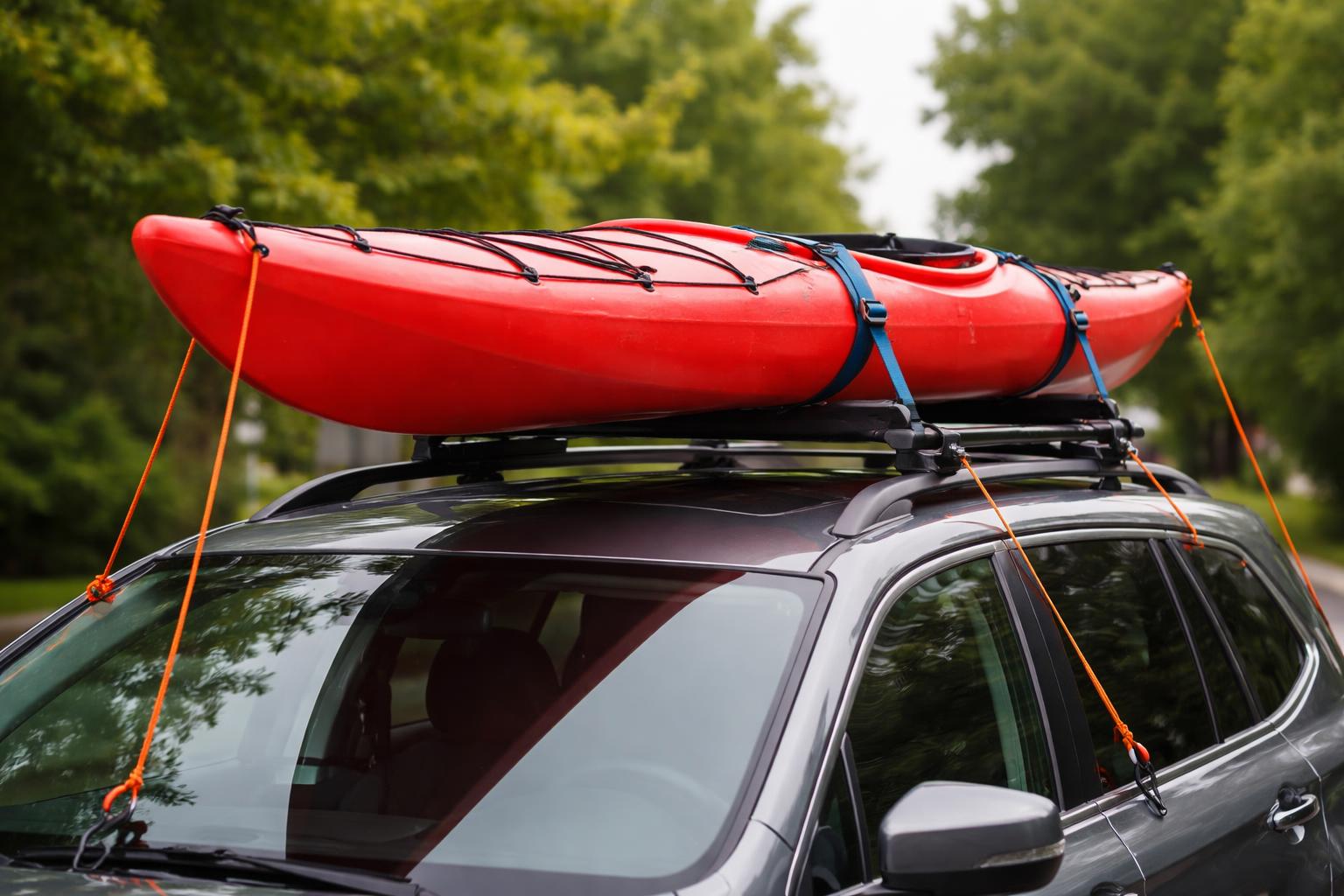
If you’re wondering how to transport a kayak without damaging it, your car, or anyone on the road, the core rule is simple: use two cam straps rated well above your kayak’s weight, plus bow and stern lines anchored to your vehicle whether you’re using a roof rack, foam blocks, a truck bed, or a trailer. Skipping the bow and stern lines is one of the most common causes of a kayak shifting or lifting on top of your car at highway speed, according to paddling safety guides from REI and Paddling Magazine. (The same core principles apply whether you’re hauling a kayak or canoe, though this guide focuses on kayaks specifically.)
Below, we break down the easiest way to transport a kayak using all 7 methods, help you figure out which one fits your vehicle and budget, and walk through exactly how to strap, lift, and load your kayak onto your car without damaging it.
7 Ways to Transport a Kayak at a Glance
| # | Method | Best For | Best Trip Length | Approx. Cost | Difficulty |
|---|---|---|---|---|---|
| 1 | Roof rack (J-cradle/saddle) | Frequent paddlers with a dedicated vehicle | Any distance, including long highway trips | $150–$400 | Moderate (one-time setup) |
| 2 | Foam blocks / pool noodles | Occasional paddlers who don’t have a rack | Short-to-moderate trips, lower speeds | $15–$40 | Easy, but slower to rig each time |
| 3 | Truck bed | Truck owners, shorter kayaks | Any distance | $0–$200 (with extender) | Easy |
| 4 | Kayak trailer | Multiple kayaks, heavy fishing kayaks | Any distance, best for frequent/heavy use | $400–$1,500+ | Easy loading, higher setup cost |
| 5 | Inflatable/foldable kayak (packed) | No roof access, small cars | Any distance no rooftop exposure at all | $0 | Very easy |
| 6 | Two-kayak roof setup | Couples, tandem trips, transporting more than one kayak | Any distance | $200–$500 | Moderate |
| 7 | SUV/hatchback interior | Short or inflatable kayaks only | Short local trips | $0 | Easy, with caveats (see below) |
Which Method Is the Easiest Way to Transport a Kayak for You?
- I paddle almost every weekend and own my car long-term → Roof rack with J-cradles or saddles (Method 1)
- I only kayak a few times a year and don’t have a rack → Foam blocks (Method 2)
- I own a truck → Truck bed transport (Method 3), with a bed extender if your kayak is longer than the bed
- I have 2+ kayaks or a heavy fishing kayak → Kayak trailer (Method 4)
- I have an inflatable or foldable kayak → Skip rooftop transport deflate and pack it (Method 5)
- I need to transport kayaks for two people → See the two-kayak roof setup section (Method 6)
- I drive a small hatchback with no roof access → Interior transport, only for short kayaks and short trips (Method 7)
Decision Tree (Including Kayak Weight)
How much does your kayak weigh (fully rigged)?
├── Under 50 lbs (recreational/inflatable)
│    ├── Have a truck? → Truck bed (Method 3)
│    ├── Inflatable/foldable? → Pack inside vehicle (Method 5)
│    └── Neither? → Foam blocks (Method 2) or roof rack (Method 1)
│
├── 50–80 lbs (touring/mid-size)
│    ├── Have a roof rack rated for this weight? → Roof rack (Method 1)
│    ├── Have a truck? → Truck bed with extender if needed (Method 3)
│    └── Transporting more than one kayak? → Two-kayak roof setup (Method 6)
│
└── 80+ lbs (heavy fishing kayak, rigged with gear)
     ├── Confirm your rack's dynamic weight rating covers this — many
     │    standard racks are rated for only 100–165 lbs total, including
     │    the rack itself (see Weight & Capacity section below)
     ├── Have a trailer or truck? → Strongly preferred over roof loading
     └── Roof-only option? → Use a loading assist bar and never lift solo
What You’ll Need to Transport Your Kayak
- 2 cam straps, sized to your kayak’s weight (see the gear table below don’t assume every cam buckle is rated the same)
- 2 bow and stern lines (rope or dedicated tie-down straps)
- Foam blocks, pads, or a roof rack system (method-dependent)
- A moving blanket or towel, to protect the roof of your car or truck bed from scratches
- A red or fluorescent orange flag, sized to your state’s requirement (commonly 18 inches square see Legal section)
- A step stool, if loading solo on a tall vehicle
Recommended Gear Table
| Item | What to Look For | Typical Price Range |
|---|---|---|
| Cam straps (pair) | Check the manufacturer’s stated Working Load Limit (WLL) on the buckle light-duty straps are commonly rated around 300–600 lbs breaking strength, heavy-duty straps 1,500+ lbs | $10–$40/pair |
| Bow/stern lines | Non-stretch rope or ratcheting tie-down kits | $10–$30 |
| Foam blocks | Roof-shaped, with a non-slip base | $15–$30 |
| J-style kayak carrier | Fits factory roof rack bars on most SUVs/sedans | $150–$300 |
| Saddle-style carrier | Better for heavier or wider kayaks | $200–$400 |
| Truck bed extender | Adjustable width, rated for kayak/canoe use | $80–$180 |
| Kayak trailer (single-axle) | Rated for your kayak’s weight plus margin | $400–$900 |
| Red/orange safety flag | At least 18 inches square (check your state) | $5–$15 |
Note: Prices and product availability change treat these as planning ranges, not live pricing.
Method 1: How to Transport a Kayak on a Roof Rack
Types of Roof Racks (J-Style Kayak Carriers vs. Saddles)
| Carrier Type | Description | Best For |
|---|---|---|
| J-style kayak carrier | Holds the kayak on its side at an angle, freeing space on the roof rack’s crossbars for a second kayak or gear | Multiple kayaks, narrow vehicles |
| Saddle-style carriers | Wide, padded, stable base that keeps the kayak centered and distributes weight evenly | Heavier kayaks, long-distance trips |
| Flat roof rack bars with foam pads | Simple, budget-friendly setup resting the kayak directly on padded bars | Occasional paddlers upgrading from foam blocks |
Pros: Most secure way to transport a kayak at highway speed; frees up interior/trunk space; works for most kayak types and weights.
Cons: Higher upfront cost; requires roof rails or a rack system’s crossbars to already be installed; getting the kayak onto the roof can be difficult solo without an assist bar.
How to Strap Your Kayak to a Roof Rack
- Lift the kayak onto your car and center it on the crossbars hull-down, or on its side at an angle if you’re using a J-style kayak carrier
- Run cam straps over the kayak and around the roof rack’s crossbars, snug but not overtightened (see below on why over-tightening is a real risk)
- Attach bow and stern lines to sturdy anchor points on the front of the car and rear of the car (tow hooks, frame tie-downs) never to plastic trim
- Make sure the kayak is centered and the kayak is securely fastened before pulling away perform the shake test (see safety checklist)
Pro tip: Cam straps loosen gradually from road vibration. Many experienced paddlers build in a habit of re-checking straps early in a long drive for example, at the first fuel or rest stop rather than assuming a strap that was tight in the driveway will hold the kayak in place for hours.
Method 2: How to Transport a Kayak Without a Roof Rack
Foam Blocks and Pool Noodles
If you don’t have a rack installed, foam blocks or pool noodles are a common budget way to get your kayak onto the roof of your car. They sit directly on top of your car, cushioning the hull and creating a stable base to secure a kayak without a permanent rack system.
Pros: Inexpensive; no permanent modification to your vehicle’s roof rack; easy to store between trips. Cons: Lower weight capacity than a dedicated rack; more time-consuming to set up correctly each time; generally considered less secure for long highway hauls or high winds by most paddling guides.
How to Secure the Kayak to the Roof of Your Car
- Position foam blocks under the kayak’s widest points, roughly where the roof rack’s crossbars would sit
- Run two long cam straps through your car’s open doors, over the kayak, and around the blocks
- Cinch down firmly not excessively to avoid hull deformation
- Attach bow and stern lines to tow hooks or frame anchor points at the front of the car and rear of the car with this method, most experienced paddlers treat these lines as essential rather than optional, since there’s no rack system to anchor the kayak’s lateral position and ensure the kayak stays in place
Method 3: How to Transport a Kayak in a Truck Bed
Best Practices for Loading a Kayak Onto a Truck Bed
- Short kayaks: Lay flat on a bed liner or thick moving blanket
- Long kayaks (overhanging the tailgate): Use a bed extender to support the stern of the kayak and reduce bounce
- Load bow-first to minimize wind resistance
Strapping Techniques for Stability
Use cam straps through the truck’s tie-down points, securing front-to-back and side-to-side movement so the kayak is centered and can’t shift. For kayaks extending past the tailgate, add a separate strap pulling the stern of the kayak down onto the extender, plus a flag on any overhang that meets your state’s threshold (see Legal section).
Pros: No roof lifting required the easiest way to transport a kayak if you already own a truck. Cons: Limited to kayaks that fit (or nearly fit) the bed length.
Method 4: Kayak Trailer Transport
Choosing the Right Kayak Trailer
Best for paddlers who need to transport more than one kayak, or a heavy fishing kayak (see the dedicated section below). Single-axle trailers suit most recreational paddlers; heavier kayaks may need a reinforced model. Established brands in this space include Malone and Yakima, both of which publish weight ratings for their trailer systems always check the specific model’s rating against your kayak’s actual weight rather than assuming.
Loading and Securing the Kayak on a Trailer
- Position the kayak on the trailer’s crossbars or cradles, weight evenly distributed
- Secure with cam straps around the trailer frame or crossbars
- Add bow and stern lines to prevent fore-aft movement at highway speed
- Confirm the trailer’s brake lights, turn signals, and registration are road-legal in your state
Pros: No need to lift the kayak onto a roof; handles multiple or heavy kayaks well. Cons: Highest upfront cost; requires towing capacity and trailer storage; subject to separate state trailer-registration rules.
Method 5: Transporting an Inflatable or Foldable Kayak
If you own an inflatable or foldable kayak, you can often avoid rooftop or truck transport entirely by deflating or folding it into its carry bag and storing it in the trunk, back seat, or cargo area. This sidesteps straps, roof racks, and overhang rules altogether, and is typically the lowest-cost way to transport a kayak on this list. The trade-off is setup/breakdown time at each end of your trip, and inflatable kayaks generally have lower weight capacity and durability than hardshell kayaks factors worth weighing if you paddle frequently or in rougher water.
Method 6: How to Transport Two Kayaks at Once
- Roof rack: Use stacked J-style kayak carriers (two kayaks on their sides, angled) rather than saddles, which typically fit only one kayak per set of crossbars
- Weight distribution: Confirm your rack’s total dynamic weight rating covers both kayaks combined see the Weight & Capacity section below
- Strapping: Each kayak needs its own cam straps and its own bow/stern lines don’t share a single strap across both, and make sure each kayak is centered independently
- Trailer alternative: If you regularly need to transport more than one kayak, a trailer is often more practical and reduces the lifting burden compared to a double roof load
Method 7: Transporting a Kayak Inside Your Car
For short kayaks (roughly under 10 feet) or inflatables, some hatchbacks and SUVs can fit a kayak inside with the rear seats folded down.
Important caveat: An unsecured rigid object inside the passenger cabin is a real safety hazard during sudden braking or a collision this isn’t a minor detail. If you use this method:
- Secure the kayak firmly to a cargo anchor point with a strap so the kayak stays in place never leave it loose
- Keep the load out of the space directly behind the driver and front passenger seats where possible
- Treat this as a short-trip, low-speed option, not a substitute for a proper external transport method on highway drives
For most paddlers, Method 5 (deflate/pack) or a roof/truck method is the safer choice; interior transport of a rigid hardshell kayak should be a last resort.
Heavy & Fishing Kayak Considerations
Rigged fishing kayaks with seats, rod holders, electronics, and battery packs installed commonly weigh significantly more than an unrigged hull, and many models exceed 80–100 lbs once fully outfitted. Always check your specific kayak’s rigged weight against your gear’s ratings rather than assuming.
- Roof racks: Confirm your rack and vehicle’s roof rack are rated for the kayak’s fully-rigged weight, not just the base hull weight (see Weight & Capacity below)
- Lifting: Avoid lifting a heavy fishing kayak solo without an assist device (loading bar, rear-load extender) or a second person to help carry the kayak
- Trailers are often the safer call for heavier kayaks, since they remove the lifting problem and roof-capacity concerns entirely
- Remove accessories first detach fish finders, rod holders, and battery packs before transport to reduce weight and prevent damaging your kayak
Weight & Capacity Considerations
Before choosing a method, check three separate numbers don’t assume they’re the same:
- Your kayak’s actual weight, fully rigged if it’s a fishing kayak (manufacturer spec sheet)
- Your roof rack’s dynamic weight rating the limit while driving. Aftermarket crossbar systems commonly carry dynamic ratings in the 100–165 lb range (Yakima and Thule both publish 165 lbs as a common ceiling for many vehicles), though this varies by vehicle and rack model
- Your vehicle’s own roof load rating, found in your owner’s manual this is the number that actually governs, even if your rack is rated higher
Static weight capacity (while parked, e.g., for a rooftop tent) is typically much higher than dynamic capacity Yakima lists up to 600 lbs static on some systems but static capacity does not apply while driving. Always use the lowest of the three numbers above, and if your kayak’s weight is close to that limit, a truck bed or trailer removes the guesswork entirely.
Sources: Yakima “CrossBar Weight Limits” and “Weight Limits” support pages; Thule Motion XT product manual.
How to Lift and Load a Kayak Onto Your Car
Lifting Techniques: Solo vs. Partner
Solo: A common technique is the “hip carry and roll” rest one end of the kayak on the rear crossbar or foam block, then lift and guide the other end up and over using your legs, not your back. Bend at the knees throughout, and if the kayak is heavy, use a loading assist bar rather than muscling it onto the roof alone.
With a partner: One person supports the bow, the other the stern of the kayak. Lift in unison and communicate clearly throughout so you don’t end up damaging your kayak or the car.
Getting Your Kayak Onto the Roof, Step by Step
- Rest one end on the rear crossbar or foam block, at the back of the car
- Walk to the other end, lift, and slide the kayak into place on top of your car (solo) or guide it together (partner)
- Center the kayak and align it with the cradles or saddles so the kayak is centered front-to-back and side-to-side
- Avoid dragging the kayak across the roof this scratches both the kayak and your vehicle’s roof rack
Safety Tips for Loading
Clear the area around your vehicle before lifting, wear footwear with good grip, and check for overhead obstacles like garage doors or low branches before you get your kayak on top of the car. A rear-loading assist bar can significantly ease solo loading by giving you a temporary pivot point.
Kayak Transport Safety Checklist
- [ ] Cam straps snug, not overtightened
- [ ] Bow line attached to a sturdy anchor point at the front of the car
- [ ] Stern line attached to a sturdy anchor point at the rear of the car
- [ ] Shake test performed no wobble or shift, kayak is securely fastened
- [ ] Flag attached if overhang meets your state’s threshold
- [ ] Straps rechecked early into a long drive (e.g., at the first stop)
- [ ] Roof rack’s dynamic weight rating confirmed against kayak weight
- [ ] Clear path checked for overhead obstacles before loading
- [ ] Trailer lights and registration confirmed (if applicable)
Vehicle-Specific Tips for Transporting a Kayak
| Vehicle Type | Recommended Method | Notes |
|---|---|---|
| Sedan | Foam blocks or a lightweight roof rack | Check your owner’s manual roof load rating before adding a rack system |
| SUV/Crossover | Roof rack (J-style kayak carrier or saddle) | Usually already has roof rack bars for easier installation |
| Pickup truck | Truck bed + extender | Best all-around option if the kayak fits with minimal overhang |
| Hatchback | Foam blocks or short-trip interior transport | Limited space on the roof of your car measure before buying a rack |
| Minivan | Roof rack or interior transport with seats folded | Higher interior cargo volume, good for transporting more than one kayak |
Legal and Safety Considerations When You Transport a Kayak
Important: Overhang, flagging, and lighting rules are set at the state level in the U.S. and vary meaningfully there is no single nationwide rule for passenger vehicles carrying a kayak. The figures below use California as a documented, sourced example. Always verify your own state’s current DMV/DOT rules, especially before a long trip or one that crosses state lines.
Worked Example: California
Under the California Vehicle Code:
- Front overhang beyond the front of the car is limited to 3 feet beyond the front bumper or tires (CVC §35406)
- A load extending 4 feet or more beyond the rear of the car must display a red or fluorescent orange flag or cloth at least 18 inches square (CVC §24604)
- A load extending more than 4 inches beyond the side of the car also requires a flag under the same size rule (CVC §25104(b))
- At night, red lights visible from 500 feet are required in addition to, or instead of, flags
(Source: California Department of Transportation, “Overhang,” dot.ca.gov)
Other States Vary
Some states allow more rear overhang (for example, several sources document up to 5–6 feet before flagging requirements apply in certain states), while others align closely with California’s federal-influenced 3-foot/4-foot pattern. Flag size requirements you’ll see cited range from 12 to 18 inches square depending on the state 18 inches square is the more commonly documented figure in state vehicle codes reviewed for this article, but confirm your specific state before relying on a smaller flag.
Action step: Search “[your state] DMV overhang flag requirements” before a trip with significant kayak overhang, or check your state’s official transportation department site directly.
Speed and Handling
Added wind resistance and weight from a rooftop or trailer load affect braking distance and handling. Reduce speed, increase following distance, and avoid sudden lane changes when carrying a kayak a widely echoed recommendation across paddling and towing safety guides, even where no kayak-specific speed limit exists.
Common Mistakes to Avoid When You Strap Your Kayak
| Common Error | Potential Consequence |
|---|---|
| Overtightening straps | Hull deformation or cracking (especially plastic kayaks) this is why cam straps, which cap tension at what your arm can pull, are generally recommended over ratchet straps for kayaks |
| Insufficient strap tension | Shifting, abrasive damage, or dislodgement the kayak is no longer securely fastened |
| Neglecting bow and stern lines | Lift and sway at highway speeds |
| Skipping the shake test | Undetected loose straps before driving |
| Ignoring the roof rack’s crossbars weight rating | Roof or rack stress, potential failure |
| Using ratchet straps on a plastic hull | Ratchets can generate far more clamping force than a cam buckle and are more likely to crush or deform a rotomolded hull, damaging your kayak |
FAQs on How to Transport a Kayak
1. What is the safest way to transport a kayak?
A properly installed roof rack with suitable kayak cradles is one of the most secure options for regular transport. Use two cam straps to secure the kayak and add bow and stern lines to reduce movement and lift.
2. Can I transport a kayak without a roof rack?
Yes. Foam blocks or pool noodles can provide a temporary roof support system. Secure the kayak with cam straps through the vehicle doors and use bow and stern lines to help prevent shifting or lift.
3. How do you strap a kayak to a car?
Center the kayak on the rack or padding, then run two cam straps over the hull and around the crossbars or appropriate anchor points. Tighten them firmly without overtightening, then secure the bow and stern.
4. Do I need bow and stern lines when transporting a kayak?
Bow and stern lines provide additional protection against forward, backward, and upward movement, particularly during highway travel. Attach them to strong vehicle anchor points rather than plastic trim or weak attachment points.
5. Can I transport two kayaks on one vehicle?
Yes. A suitable roof-rack system with J-cradles can accommodate two kayaks if the combined weight is within the vehicle and rack limits. Each kayak should have its own properly rated straps and appropriate bow and stern lines.
6. What is the best way to transport a heavy fishing kayak?
For a heavy or fully rigged fishing kayak, a truck bed, trailer, or loading-assist system can reduce the need for difficult roof lifting. Always check the kayak, rack, and vehicle weight ratings before choosing a transport method.
7. Can I transport a kayak in a truck bed?
Yes. Shorter kayaks can often be secured directly in the truck bed. For longer kayaks that extend beyond the tailgate, a properly sized bed extender can provide additional support and help reduce bouncing.
8. How much weight can a kayak roof rack hold?
The limit depends on both the roof-rack system and your vehicle’s dynamic roof-load rating. Always follow the lower applicable limit and check the manufacturer’s specifications before loading a kayak.
9. How often should I check kayak straps while driving?
Check the straps before leaving, then recheck them after the first 15–20 minutes of driving. On longer journeys, inspect the straps and attachment points periodically, especially after driving over rough roads or in strong wind.
10. What is the cheapest way to transport a kayak?
If you don’t already own a roof rack or truck, foam blocks or pool noodles can be an inexpensive option for occasional trips. Make sure the setup is properly secured and suitable for your vehicle and kayak.
Final Thoughts
The right way to transport a kayak comes down to three questions: what vehicle you drive, how often you paddle, and how much kayak (or how many kayaks) you need to transport. Whichever method you choose, the fundamentals stay the same properly rated cam straps, bow and stern lines, and a shake test to confirm the kayak is securely fastened before you pull out of the driveway.
Next step: Measure your kayak’s actual weight and check your vehicle’s roof load rating in the owner’s manual before buying any gear it’s the single fastest way to rule out unsafe options and narrow down which of the 7 methods above actually fits your setup.