Choosing the right trolling motor for your boat comes down to more than simply picking the highest thrust number or the motor with the most features. If you’re wondering how to choose the right trolling motor, start by matching it to your boat’s fully loaded weight, hull size, mounting position, shaft length, voltage, fishing environment, and how you actually spend your time on the water. Get those factors right, and your motor can hold position confidently, handle wind and current, and give you the control you need throughout a full day of fishing.
I’ve spent 18 years rigging, repairing, and sizing trolling motors, and I’ve seen the same expensive mistakes repeatedly. Anglers calculate thrust from the boat’s dry weight, choose a shaft that’s too short, install a 24V motor without properly planning the battery bank, or buy a freshwater model for occasional saltwater trips. The motor may work initially, but performance, runtime, and reliability can suffer when the setup doesn’t match the boat.
That’s why this Complete 2026 Buyer’s Guide focuses on the numbers that actually matter. You’ll learn how to calculate the thrust you need, choose between bow and transom mounting, determine whether you need a 12V, 24V, or 36V system, measure for the correct shaft length, estimate realistic battery runtime, and decide whether features such as GPS Spot-Lock, sonar integration, brushless technology, and lithium batteries are worth the extra money.
If you only remember one thing, remember this: don’t choose a trolling motor by boat length alone. Start with your fully loaded boat weight, calculate your minimum thrust, then match the motor’s voltage, shaft, mount, and features to your fishing conditions. This guide will walk you through each step so you can buy with confidence instead of discovering your motor is underpowered after you’re already on the water.
Ready to upgrade your kayak? Check out our guide to the Best Kayak Trolling Motors and find the right motor for your setup.
⚡ Quick Answer
- Match thrust to boat weight: 2 lbs of thrust per 100 lbs of fully loaded boat weight, minimum.
- Bow-mount motors give the best control on boats over 16 ft; transom-mount suits kayaks and jon boats.
- Voltage follows thrust, not the other way around: 12V up to 55 lbs, 24V for 70–90 lbs, 36V for 112–115 lbs of thrust (per Minn Kota specs).
- Saltwater environments call for a corrosion-rated motor manufacturers advise against running a freshwater-rated unit in salt or brackish water.
- Budget realistically: $300–$700 entry, $800–$1,500 mid-range, $1,500+ for GPS/spot-lock premium models.
Before You Buy: Quick Spec Check
Confirm these five numbers before you shop they’ll narrow the entire market down to a handful of models:
| Spec | How to Find It | Your Number |
|---|---|---|
| Fully loaded boat weight | Boat + fuel + battery bank + gear + passengers | _______ lbs |
| Minimum thrust | Loaded weight ÷ 100 × 2 | _______ lbs |
| Voltage | 12V / 24V / 36V based on thrust (see table below) | _______ V |
| Shaft length | Mount-to-waterline + 20″ (bow) or +16″ (transom) | _______ in |
| Water type | Freshwater or saltwater-rated | _______ |
Introduction
I’ve re-rigged more boats than I can count, and the best trolling motor is the single upgrade I get the most panicked phone calls about. Someone buys a motor based on a friend’s recommendation, bolts it on, and discovers three weeks later that it can’t hold position in a 15-knot crosswind. That’s not a defect it’s a sizing mistake, and it’s almost always avoidable.
This guide isn’t a rehash of a spec sheet. It’s built from years spent sizing motors for everything from 10-foot jon boats to 22-foot bay boats, replacing corroded shafts that were never rated for saltwater, and troubleshooting battery banks that couldn’t get anglers through a full day. Every voltage, thrust, and amp-draw figure below is cross-checked against manufacturer specification sheets not estimated so you can shop with real numbers instead of a sales rep’s rule of thumb.
Want to protect your kayak this winter? Learn How to Store a Kayak in Winter the right way and avoid costly damage.
Understanding Trolling Motors
What Is a Trolling Motor?
A trolling motor is a low-speed, electric propulsion unit used for precise boat positioning holding a spot against wind or current, easing into skinny water, or working a shoreline without spooking fish. It’s separate from your main outboard and is mounted at the bow or transom, depending on boat type and fishing style.
Bow Mount vs. Transom Mount At a Glance
| Feature | Bow Mount | Transom Mount |
|---|---|---|
| Best for | Bass boats, bay boats, larger rigs | Kayaks, jon boats, small aluminum boats |
| Control style | Pulls the boat more precise | Pushes the boat simpler |
| Typical price | $800 and up | $300–$900 |
| Installation | Bow bracket, more involved | Clamp-on, quick install |
| Best control features | GPS spot-lock, foot pedal, wireless remote | Tiller handle, basic speed control |
How a Trolling Motor Works
An electric motor draws power from your battery bank and spins a prop that generates thrust, measured in pounds. The motor shaft runs from the mount down into the water; its length determines how deep the prop sits. Higher-end units add GPS anchor-lock, wireless remotes, and sonar useful, but secondary to getting the core specs right first.
A Simple Decision-Making Framework
Skip the guesswork. Work through these four questions in order each one narrows your options before you spend a dollar.
- What is my fully loaded boat weight? (boat + motor + fuel + battery bank + gear + passengers) this sets your minimum thrust.
- Where do I fish fresh, salt, or both? This determines whether you need a corrosion-rated saltwater series.
- What’s my boat size and mount style? Under 16 ft or a kayak/jon boat → transom mount. Bass or bay boat → bow mount.
- What’s my realistic budget? This decides whether you can add spot-lock, sonar, or lithium batteries now or later.
Once you have answers to all four, the tables below will tell you almost exactly which motor category to shop in.
Need better fishing storage? Explore our guide to Kayak Fishing Crates and organize your gear more efficiently.
Thrust Calculator: The Formula
Minimum Thrust (lbs) = Fully Loaded Boat Weight (lbs) ÷ 100 × 2
Fully loaded weight = boat + motor + full fuel tank + battery bank + gear + all passengers. For rough water, wind, or current, multiply your result by 1.25–1.3 to build in a safety margin.
Worked example: A boat that weighs 2,400 lbs fully loaded needs at minimum 2,400 ÷ 100 × 2 = 48 lbs of thrust. If you regularly fish windy open water, multiply by 1.3: 48 × 1.3 ≈ 62 lbs of thrust which pushes you toward a 55–70 lb motor rather than cutting it close at the bare minimum.
Thrust Calculation Table
Using the formula above, here’s how the numbers work out across common boat weights. This aligns with Minn Kota’s official thrust and voltage recommendation chart, so the figures below reflect real manufacturer guidance rather than a rounded rule of thumb.
| Fully Loaded Boat Weight | Minimum Thrust | Recommended Thrust (windy/current) | Typical Voltage |
|---|---|---|---|
| Up to 1,599 lbs | 30–40 lbs | 40–52 lbs | 12V |
| 1,600–2,599 lbs | 40–55 lbs | 52–72 lbs | 12V |
| 2,600–3,599 lbs | 70–80 lbs | 80–100 lbs | 24V |
| 3,600–4,599 lbs | 80–90 lbs | 100+ lbs | 24V |
| 4,600–5,599 lbs | 112–115 lbs | 115 lbs (max) | 36V |
| 5,600+ lbs | 112–115 lbs | 115 lbs (max) | 36V |
Source: Minn Kota Trolling Motor Selection & Boat Size Guide (minnkota.johnsonoutdoors.com)
Don’t forget: “fully loaded” means boat + full fuel tank + battery bank + gear + every passenger you’ll typically carry. A boat weighed empty at the dealership is not the number you should be calculating against.
Want to stay securely in one spot? Learn How to Anchor a Kayak safely and confidently in different conditions.
Boat-Type Recommendations
Here’s how thrust, mount type, and voltage typically line up by boat category:
| Boat Type | Typical Mount | Thrust Range | Voltage |
|---|---|---|---|
| Kayak / Canoe | Transom | 30–55 lbs | 12V |
| Jon Boat (10–14 ft) | Transom or Bow | 40–55 lbs | 12V |
| Aluminum Fishing Boat (14–16 ft) | Bow | 55 lbs | 12V |
| Bass Boat (16–18 ft) | Bow | 70–80 lbs | 24V |
| Bass Boat / Bay Boat (18–20 ft) | Bow | 80–90 lbs | 24V |
| Bay Boat / Pontoon (20–23 ft) | Bow | 112–115 lbs | 36V |
| Large Center Console (24+ ft) | Bow | 112–115 lbs | 36V |
Note: a small number of premium brushless motors Garmin’s Force Kraken and Minn Kota’s Riptide Instinct QUEST are dual-voltage, meaning the same motor can be wired at 24V (roughly 90 lbs of thrust) or 36V (roughly 115 lbs of thrust). These bridge the gap between standard 24V and 36V tiers if your boat falls between categories.
Source: Trolling Motor Thrust Guide, TrollingMotors.net
Taking your kayak on the road? Learn How to Transport a Kayak safely without damaging your boat.
Voltage and Battery Requirements
Voltage determines how much power reaches the motor and how many batteries you’ll need to wire together. These figures come directly from Minn Kota’s published voltage/thrust specifications:
| System | Thrust Range | Batteries Required | Best For |
|---|---|---|---|
| 12V | Up to 55 lbs | 1 × 12V deep-cycle | Kayaks, jon boats, small-to-mid aluminum boats |
| 24V | 70–90 lbs | 2 × 12V in series | Mid-size aluminum boats, 16–20 ft bass/bay boats |
| 36V | 112–115 lbs | 3 × 12V in series | Larger bass boats, bay boats, big rigs |
Source: Minn Kota, “How to Select Trolling Motor Thrust” (minnkota.johnsonoutdoors.com), confirmed against TrollingMotors.net’s General Voltage/Thrust Ratios
Notice the gap between 90 lbs (top of 24V) and 112 lbs (bottom of 36V). That’s intentional on the manufacturer side, not a typo there simply aren’t many standard 12V/24V/36V motors built in that window, aside from the dual-voltage models mentioned above. If your calculated thrust need lands in that gap, round up to the 36V tier rather than settle for an underpowered 24V motor.
A mistake I see constantly: buying a 24V or 36V motor and trying to run it on mismatched or aging batteries. Voltage sag from an old battery in the series will tank your thrust output even if the motor itself is rated correctly.
Shaft Length: Finding the Right Fit
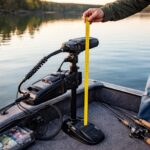
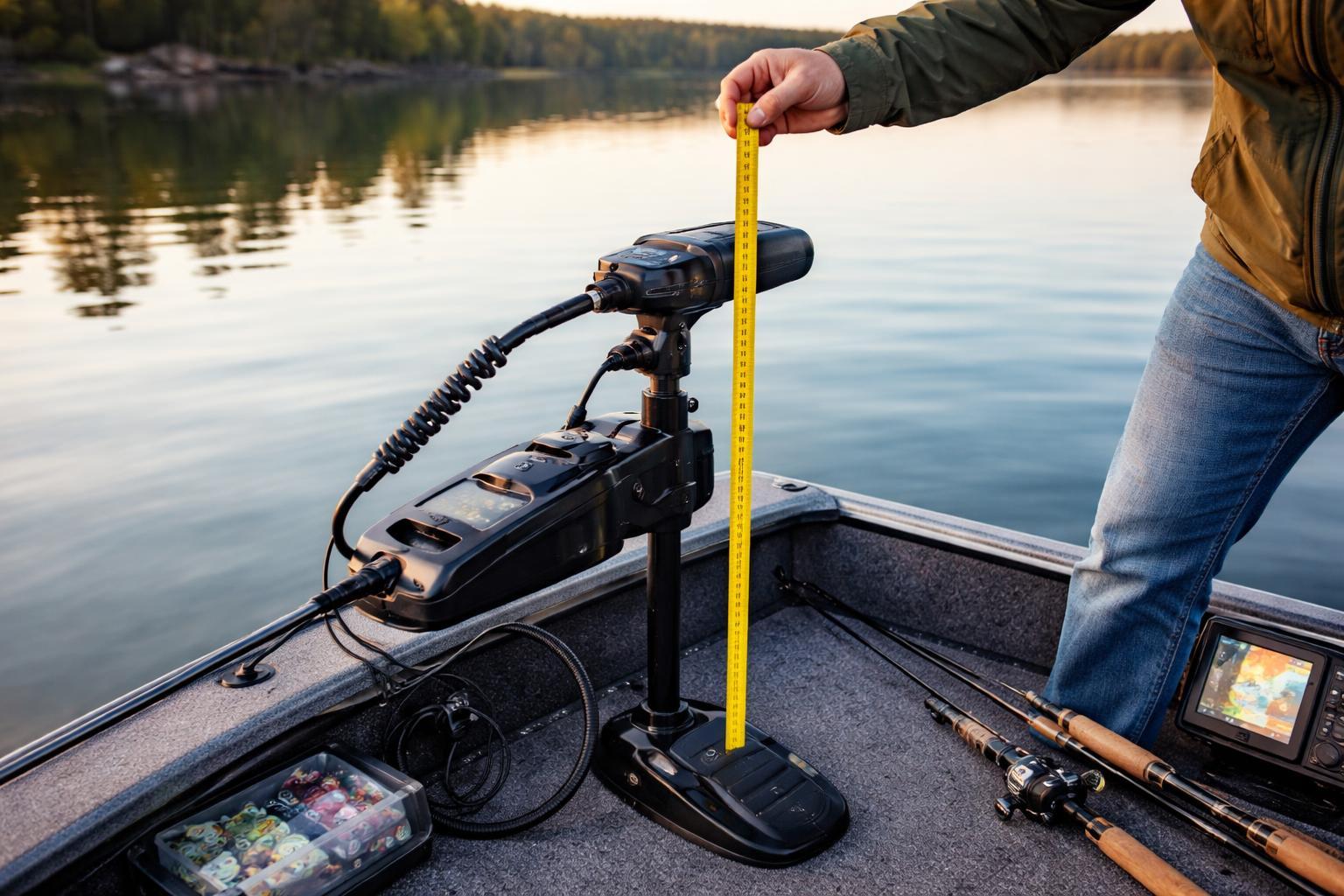
Formula: measure from the mounting surface to the waterline, then add 20″ for bow mount or 16″ for transom mount. This keeps the prop submerged even when you’re punching through wakes or chop.
| Mount Type | Freeboard Height (mount to waterline) | Recommended Shaft Length |
|---|---|---|
| Transom | 12–16 inches | 30 inches |
| Transom | 16–20 inches | 36 inches |
| Bow | 16–20 inches | 42 inches |
| Bow | 20–24 inches | 48 inches |
| Bow | 24–28 inches | 54–60 inches |
Too short, and the prop breaks the surface in rough water you’ll hear it, and you’ll lose thrust instantly. Too long, and deployment gets awkward and you risk striking bottom in shallow water. When between sizes, I always round up.
Looking for better fish-finding performance? Discover the Best Fish Finders for Kayak fishing and choose the right option.
Battery Runtime: How Long Will You Actually Fish?
Runtime example used below: a 12V system running a single 55 lb-thrust motor on one fully charged 12V / 100Ah AGM deep-cycle battery. Published amp-draw data for this motor class shows a maximum draw of roughly 50 amps at full speed.
| Speed Setting | Approx. Amp Draw | Runtime on a 12V / 100Ah AGM Battery |
|---|---|---|
| Low (1–3) | ~8–12 amps | 8–12 hours |
| Medium (4–6) | ~20–30 amps | 3–5 hours |
| High (7–10 / Max) | ~50 amps | ~2 hours |
Energy in watt-hours (Wh): runtime ultimately comes down to total stored energy, not just amp-hours. Watt-hours = Voltage × Amp-hours. A single 12V / 100Ah battery stores 12 × 100 = 1,200Wh. A 24V bank (two 12V/100Ah batteries in series) stores 24 × 100 = 2,400Wh, and a 36V bank (three 12V/100Ah batteries) stores 36 × 100 = 3,600Wh. Each individual battery is still “100Ah,” but wiring them in series multiplies total available energy which is why higher-voltage systems generally deliver longer effective runtime even though the amp-hour rating per battery hasn’t changed.
Important: these runtimes assume a lead-acid AGM battery discharged close to its usable limit. To protect battery lifespan, most manufacturers recommend not discharging lead-acid batteries below 50% so practical, battery-safe runtime is roughly half the figures above unless you’re using lithium (see below).
For 24V and 36V systems, each individual battery is still rated in the same amp-hours runtime per battery doesn’t change, but total system capacity and efficiency improve because the motor draws fewer amps per volt to produce the same thrust. In practice, a 24V or 36V rig will often outlast an equivalent 12V setup on a full day of mixed-speed use.
Want hands-free fishing power? Check out the Best Pedal Kayaks for Fishing and find a model that fits your needs.
Lithium vs. Lead-Acid Batteries
This is one of the biggest performance upgrades available, and it’s not just about weight.
| Factor | Lead-Acid (AGM) | Lithium (LiFePO4) |
|---|---|---|
| Weight (100Ah) | 60–65 lbs | 25–30 lbs |
| Usable capacity | ~50% of rated (avoid deep discharge) | ~95–100% of rated |
| Lifespan | 300–500 cycles | 2,000–5,000+ cycles |
| Upfront cost | $150–$300 | $800–$1,200 |
| Voltage consistency | Drops as it discharges | Stays steady until nearly empty |
| Best for | Casual anglers, tight budgets | Frequent anglers, tournament use, weight-sensitive boats |
Lithium costs more upfront, but the steady voltage output means your motor keeps performing at rated thrust even late in the day lead-acid motors noticeably weaken as the battery drains. Because lithium delivers close to 100% of its rated capacity (versus ~50% usable on lead-acid), a 100Ah lithium battery effectively performs like a 180–200Ah lead-acid bank in real-world runtime. Over a 5-year span, lithium often wins on cost-per-cycle despite the higher sticker price.
Ready to customize your setup? Learn the essentials of Kayak Fishing Rigging and make your kayak work harder for you.
Brushless vs. Brushed Motors
| Factor | Brushed Motor | Brushless Motor |
|---|---|---|
| Efficiency | Standard | 10–20% more efficient per amp draw |
| Noise | Noticeable hum | Nearly silent better for spooky fish |
| Maintenance | Brushes wear and need replacement | No brushes to wear minimal upkeep |
| Lifespan | Shorter, more moving parts wear | Significantly longer service life |
| Price | Lower | Higher, typically mid-to-premium tier |
If stealth matters bed fishing, clear water, pressured lakes brushless is worth the premium. For casual or occasional use, a quality brushed motor is still a perfectly reliable choice.
Freshwater vs. Saltwater: What to Consider
Saltwater is corrosive to standard electronics and hardware. Motors built for salt use sealed electronics, stainless hardware, and specific coatings Minn Kota’s Riptide series is a common example. Manufacturers generally advise against using a freshwater-rated motor in salt or brackish water; doing so typically accelerates corrosion, can void the warranty, and often shortens the motor’s usable life within a season or two.
Wondering what you should budget? Find out How Much Does a Kayak Cost and what affects the final price.
Budget Tiers: What You Get for Your Money
| Tier | Price Range | What’s Included |
|---|---|---|
| Entry-level | $300–$700 | Manual steering, basic thrust options, limited features |
| Mid-range | $800–$1,500 | Wireless remote, brushless motor options, basic sonar compatibility |
| Premium | $1,500+ | GPS spot-lock, integrated sonar, high-thrust 24V/36V systems |
Features Worth Paying For
Once your thrust, voltage, and shaft length are locked in, feature selection is where budget actually gets spent. Here’s what’s genuinely worth the upgrade and what’s optional:
- GPS Spot-Lock / Anchor Mode holds your position within a few feet without constant manual correction. The single highest-value feature for solo anglers or anyone fishing structure.
- Wireless Remote / Foot Pedal Combo lets you steer hands-free while casting. Especially valuable on bow-mount setups where you’re standing most of the day.
- Sonar / Fish-Finder Integration built-in transducers on the motor head reduce clutter and give you real-time bottom and fish data right where you’re steering.
- Digital Display / Battery Meter shows real-time battery percentage instead of guessing genuinely useful for planning a full day on the water.
- Quick-Release Mounting Bracket worth it if you trailer often; saves wear on the bow bracket and speeds up launch/load.
- Weedless Prop Design prevents weed fouling in grassy or heavily vegetated water skip it if you fish mostly open, clear water.
Skip: integrated Bluetooth speakers, cosmetic LED lighting, and app features that duplicate what your existing fish finder already does these add cost without meaningfully improving performance.
Looking for an easy, comfortable kayak? Explore the Best Recreational Kayaks and find your ideal match.
Top Mistakes to Avoid
- Underestimating thrust by calculating off the boat’s dry weight instead of fully loaded weight.
- Guessing on shaft length instead of measuring mount-to-waterline distance.
- Using a freshwater motor in saltwater the single most expensive mistake anglers make.
- Undersizing the battery bank for the voltage the motor actually requires.
- Ignoring runtime needs for full-day trips, then being stranded mid-afternoon.
Recommended Brands
Minn Kota is the most established name in the category, with the Ulterra and Terrova series offering strong GPS features and a wide thrust range. Garmin Force motors have earned a strong reputation for brushless efficiency, quiet operation, and integrated sonar. Both are sold through major retailers including Bass Pro Shops and West Marine, and either is a safe long-term investment when properly sized to your boat.
Real-World Scenarios
Saltwater Fishing
Corrosion resistance matters most here a saltwater-rated series and higher thrust are strongly recommended to handle stronger current in bays, estuaries, and nearshore water.
Freshwater Fishing
Freshwater motors are generally less expensive since they skip the extra corrosion protection. A 12V or 24V setup with a foot pedal covers most lake and river fishing comfortably.
Kayak and Jon Boat Use
Transom mount, 30–55 lbs of thrust, and a shorter shaft are usually the right combination prioritize portability and simple installation over advanced features.
Maintenance Tips for Longevity
- Rinse the lower unit and prop with fresh water after every saltwater trip.
- Check the prop regularly for fishing line, which can damage seals over time.
- Keep battery terminals clean and free of corrosion.
- Inspect shaft and mounting hardware periodically for looseness.
- Fully charge batteries after each outing rather than letting them sit depleted.
Final Buying Checklist
- [ ] Calculate fully loaded boat weight and required thrust
- [ ] Confirm mount type based on boat size (bow vs. transom)
- [ ] Measure and confirm correct shaft length
- [ ] Match voltage to thrust, and plan your battery bank accordingly
- [ ] Decide freshwater vs. saltwater rating based on where you’ll fish
- [ ] Set a realistic budget and prioritize features accordingly
- [ ] Choose lithium if you fish frequently or need consistent all-day power
Shopping on a budget? Discover the Best Kayaks Under 500 and find a quality option without overspending.
Frequently Asked Questions
How much thrust do I need for my boat?
Use 2 lbs of thrust per 100 lbs of fully loaded boat weight as your minimum, and multiply by 1.25–1.3 if you regularly fish in wind or current.
What size trolling motor do I need for a 16-foot boat?
A typical 16-foot boat, fully loaded, weighs somewhere between 1,600 and 2,600 lbs depending on hull material and gear. That puts most 16-foot boats in the 40–70 lb thrust range on a 12V or 24V system aluminum fishing boats typically land at the lower end, while 16-foot bass boats with a full battery bank often need closer to 70 lbs on 24V.
What size trolling motor do I need for a 20-foot boat?
A fully loaded 20-foot boat generally falls in the 3,600–5,600 lb range. Lighter 20-footers (roughly under 4,600 lbs loaded) typically need 80–90 lbs of thrust on a 24V system, while heavier 20-foot bay boats or pontoons often need 112–115 lbs on a 36V system. It’s worth weighing your specific boat before deciding rather than assuming based on length alone.
Can I use a freshwater trolling motor in saltwater?
It’s not recommended. Freshwater motors lack the corrosion protection built into saltwater-rated series, and manufacturers typically warn that using one in salt or brackish water accelerates corrosion and may void the warranty. If you fish salt or brackish water regularly, a saltwater-rated motor is the safer long-term investment.
What’s the difference between 12V, 24V, and 36V motors?
Voltage determines how much power is delivered and how many batteries you need. Per Minn Kota’s published specs, 12V covers up to 55 lbs of thrust, 24V covers 70–90 lbs, and 36V covers 112–115 lbs.
How do I measure for the correct shaft length?
Measure from the mounting surface to the waterline, then add 20 inches for a bow mount or 16 inches for a transom mount.
Is a bow mount or transom mount better?
Bow mount offers superior control for larger boats over 16 feet. Transom mount is simpler, more affordable, and well suited to kayaks and jon boats.
How long will my battery last on a full day of fishing?
On a single 12V / 100Ah AGM battery running a 55 lb motor, expect roughly 8–12 hours at low speed, 3–5 hours at medium speed, and about 2 hours at max speed though battery-safe usable runtime on lead-acid is closer to half of those figures.
Is lithium worth the extra cost over lead-acid?
For frequent anglers, yes lithium batteries deliver nearly all of their rated capacity versus roughly half for lead-acid, plus a much longer lifespan, often making them cheaper per year of use despite the higher upfront cost.
Are brushless motors worth the price difference?
if quiet operation and long-term durability matter to you, brushless motors are worth it. Occasional anglers on a budget will still get solid performance from a brushed motor.
What size trolling motor does a kayak need?
Most kayaks perform well with a transom-mount motor in the 30–55 lb thrust range on a 12V system.
How often should I service my trolling motor?
Rinse after every saltwater use, check the prop for line monthly, and inspect mounting hardware and battery terminals each season at minimum.
Final Verdict: How to choose the Right Trolling Motor
There’s no single “best” trolling motor only the right motor for your specific boat, water, and fishing style. If you take one thing from this guide, let it be this: size your thrust off your fully loaded boat weight using the formula above, not a guess, and match your shaft length and voltage to that number. Get those three right, and nearly any motor from a reputable brand Minn Kota, Garmin, or otherwise will serve you well for years.
For most weekend anglers on a 16–18 ft boat, a 24V bow-mount motor in the 70–80 lb thrust range with a mid-tier feature set hits the best balance of performance and price. Serious tournament anglers and saltwater regulars should lean toward 36V systems, lithium batteries, and a corrosion-rated series from the outset it costs more upfront but saves money and frustration over the life of the boat.