Choosing the right personal flotation device (PFD) is one of the most important gear decisions any kayaker makes. A quality life jacket can be the difference between a minor incident and a serious emergency, especially when you’re navigating unpredictable currents or spending hours on the water far from shore. Below, we compare the best life jackets for 2026 across fishing, budget, hot-weather, women’s fit, high-back, inflatable, and youth categories against verified manufacturer specs and buyer feedback, to help you find the best life jacket for your paddling style, whether that’s casual boating on a calm lake or a full day of kayak fishing.
How this guide was built: The picks below are based on a comparative desk analysis cross-referencing manufacturer spec sheets, official U.S. Coast Guard classifications, and aggregated retailer review data (not first-hand, in-water testing by our team). Where a spec wasn’t published by the manufacturer, we’ve noted that rather than guessing. See “Our Selection Methodology” below for full detail.
Why Choosing the Right Life Jacket Matters
Kayaking involves a seated position that many general-purpose life jackets weren’t designed around. A PFD built for generic boating can ride up around your ears, dig into your shoulders on every paddle stroke, or bunch up against a high-back kayak seat. The result: paddlers either wear a vest that fights them all day, or worse, leave it in the hatch because it’s uncomfortable which defeats the purpose entirely. A life jacket can only save your life if you’re actually wearing it, so comfort isn’t a luxury feature here; it’s a safety feature.
Kayak-specific PFDs address this with shorter torso lengths, low-profile foam panels, contoured armholes, and mesh lower-back panels designed to clear a kayak seat back.
Importance of a Proper Fit
A proper fit is the foundation of an effective life jacket. A vest that’s too loose will ride up in the water, compromising flotation and making it harder to swim or re-enter your kayak. One that’s too tight restricts your paddle stroke and causes chafing on long trips. The best kayak life jackets offer a comfortable fit that’s snug and adjustable, moving with you rather than against you without added bulk over a rash guard or rain shell. If a vest isn’t comfortable enough to wear for hours at a time, it’s the wrong vest, no matter how good its specs look on paper.
Understanding Buoyancy Ratings and Personal Flotation Device Types
The U.S. Coast Guard classifies personal flotation devices by type. Nearly every dedicated foam kayak vest on this list is Type III, the standard for paddle sports.
| PFD Type | Best For | Typical Buoyancy | Notes |
|---|---|---|---|
| Type I | Offshore, rough or remote water, slow rescue likely | 22+ lbs | Bulky; built to turn an unconscious wearer face-up not used for kayaking |
| Type II | Calm, inland water, fast rescue likely | 15.5 lbs | Bulkier, less common for kayaking |
| Type III | Kayaking, canoeing, fishing, paddle sports | 15.5–16.5 lbs | Most comfortable, most common for paddlers |
| Type V | Special-use devices includes some inflatables, but also work vests, deck suits, and rescue vests | Varies by device (15.5–22.5+ lbs) | Must be worn as labeled to count toward legal requirements |
Important clarification: Type V and “inflatable” are not the same thing, and it’s a common point of confusion. Type V is a use-case category that covers several device types including some inflatables, but also non-inflatable special-purpose vests like whitewater rescue vests and commercial work vests. Meanwhile, not every inflatable PFD is labeled Type V some inflatable belt packs (like the Onyx A/M-24 featured below) are certified as “Type V with Type III performance,” meaning they meet Type III’s continuous-wear performance standard once inflated, while still falling under Type V’s “must be worn as labeled” rule. Always check the label on the specific device it’s the only authoritative source for what type it is and how it must be worn.
For the full official breakdown, see the U.S. Coast Guard’s life jacket type guide.
Our Selection Methodology
To be fully transparent: this guide was compiled through comparative research, not hands-on, in-water product testing. We selected and ranked products using the following process:
- Started from category leaders. We identified the highest-review-volume, highest-rated kayak PFDs currently sold, prioritizing listings with hundreds to thousands of verified customer reviews over newly listed products with no track record.
- Verified specs against manufacturer sources. Buoyancy, USCG type, materials, and weight were cross-checked against official brand spec sheets and authorized retailer listings not just the first Amazon listing we found. Where manufacturers don’t publish an exact buoyancy figure, we say so rather than inventing one.
- Scored against five kayak-specific criteria:
| Criterion | What We Looked At |
|---|---|
| Fit & Mobility | Armhole cut, torso length, range of motion for a full paddle stroke |
| Kayak Seat Compatibility | Back panel height/design relative to high-back kayak seats |
| Buoyancy & USCG Approval | Confirmed Type III/V Coast Guard rating |
| Ventilation | Mesh paneling and airflow for warm-weather comfort |
| Storage & Extras | Pockets, lash tabs, D-rings most relevant for fishing use |
- Filtered by price-to-value within each category, comparing MSRP against typical street price and current feature set.
If you’ve physically tested these vests and want to add first-hand fit notes, testing photos, or a “how we tested” video, that’s the strongest addition you can make here genuine hands-on testing carries far more weight with both readers and search engines than desk research alone.
How to Choose the Best Life Jacket for Kayaking
Every paddler needs a life jacket, but “best” depends entirely on how you use your kayak. Here’s how to choose the best life jacket for your specific situation before jumping to the picks:
- Recreational flatwater paddler: Prioritize comfort and ventilation over storage. If you’re still deciding on a boat, our guide to recreational kayaks and kayaks for beginners can help you match gear to your setup.
- Kayak angler: Look for a high-back, pocket-heavy design that won’t interfere with a fishing kayak’s elevated seat. Pair it with the right kayak fishing crate setup for on-water organization.
- Budget-conscious or occasional paddler: A simple, well-reviewed, affordable life jacket under $50 covers the legal and safety basics without extra features you won’t use especially useful if you’re also watching your budget on the boat itself (see our kayaks under $500 roundup).
- Warm-climate or all-day paddler: Ventilation matters more than almost anything else an uncomfortable, overheating vest is a vest that gets left on shore.
- New to kayaking entirely: Start with our how to choose your first kayak guide and sit-on-top vs. sit-in comparison your kayak style affects which PFD back design fits best.
Finding the best fit is the single biggest factor in whether you’ll actually wear it consistently a life jacket that fits properly disappears on your body; one that doesn’t will end up under your seat instead of on your back.
Sizing: How to Get It Right
Kayak PFDs are sized by chest measurement, not shirt size, and sizing varies noticeably between brands.
- Measure around the fullest part of your chest, keeping the tape level under your arms.
- Check that number against the specific model’s size chart don’t assume your size in one brand carries over to another. NRS, Onyx, and Stearns all use different chest-inch breakpoints for the same size label.
- For kids, size by weight, not age or height a child’s vest must fit snugly to work correctly, and sizing up “for room to grow” is a common, dangerous mistake (see below).
- Once it arrives, do the pull test described in the FAQ before trusting it on the water.
Our Pick for the Best PFD Overall
The NRS Chinook OS Fishing PFD is our top overall recommendation and the best choice for most kayakers who spend real time on the water. Unlike several competitors that adapt a general paddling vest for fishing use, the Chinook was designed around a kayak/raft angler from the ground up the high-back profile is confirmed by NRS to clear raft and kayak seats specifically, buoyancy is independently confirmed at 16–16.5 lbs (among the highest of any Type III vest in this guide), and it comes from a brand with a multi-decade track record in paddlesports safety gear rather than a general sporting-goods label.
It costs more than a budget vest, but for anyone spending real hours seated in a kayak, that’s where the money shows.
Quick Comparison: Best PFDs for Kayaking 2026
Comparing the best PFDs side by side makes the trade-offs easy to see at a glance this table is designed to help you find the best PFD for your paddling style in under a minute.
| Product | Best For | USCG Type | Buoyancy | Back Design | Sizes Available | Material | Weight | Price Range |
|---|---|---|---|---|---|---|---|---|
| NRS Chinook OS Fishing PFD | Overall / Fishing | III | 16–16.5 lbs | High-back, medium profile | XS/M, M/L, L/XL, XL/XXL | 400-denier ripstop nylon | ~2 lbs | $110–170 |
| Stearns Adult Classic Series Life Vest | Budget | III | Not published (Type III standard) | Standard low-back, open-sided | Universal (30″–52″ chest), Oversize (to 60″) | Nylon shell, PE foam | ~2.1 lbs | $20–35 |
| Onyx MoveVent Dynamic Paddle Sports Vest | Hot Weather / Ventilation | III | Not published (Type III standard) | Mesh lower-back, fits high-back seats and sit-on-tops | XS/S, M/L, XL/2XL | 200-denier nylon ripstop/oxford | ~1.1–1.3 lbs | $62–90 |
| O’Neill Women’s Superlite Life Vest | Women (general paddle sports) | III | Not published (Type III standard) | Standard low-back, contoured torso | S, M, L, XL | Coated polyester shell, PE foam | ~1 lb | $40–57 |
| Onyx Kayak Fishing Life Jacket | High-Back / Kayak Seats | III | Not published (Type III standard) | High foam back with mesh lower panel | Universal, Oversize | 400-denier nylon oxford | ~1.3 lbs | $75–95 |
| Onyx A/M-24 Inflatable Life Jacket | Inflatable | V (Type III performance when inflated) | Low-profile belt/vest, uninflated until deployed | Universal (30″–52″ chest) | Nylon shell, neoprene neckline | 22.5 lbs inflated | ~1 lb uninflated | $98–210 |
| Stearns Kids Life Vest | Youth (50–90 lbs) | III | Not published (Type III standard) | Standard low-back, open-sided | Youth (50–90 lbs) | Nylon shell, PE foam | Varies by size | $20–35 |
On the links and prices: Three listings above (Stearns Classic, O’Neill Women’s, Onyx Kayak Fishing Jacket) link directly to the specific Amazon listing (ASIN) we verified during this research pass. The rest link to Amazon search results because we could not confirm a single stable ASIN across retailers/sizes at review time before publishing, replace every link with your own verified, current Amazon listing (or affiliate link) for the exact size/color you intend to feature.
Prices are ranges assembled from multiple retailer listings (NRS.com, Onyx/Stearns authorized dealers, and Amazon price-history data) during the week of September 16, 2026, and will drift treat them as directional, not live pricing, and confirm the current price before publishing or whenever you refresh this page.
A note on “buoyancy not published”: several major brands (Onyx, Stearns, O’Neill) don’t list an exact pound figure for every model on their consumer-facing spec sheets they rely on the Type III/V certification itself as the buoyancy guarantee rather than a marketed number. Where we couldn’t confirm an exact figure from an official manufacturer source, we’ve said so rather than presenting an invented number as fact.
Best Kayak Life Jackets for 2026
1. NRS Chinook OS Fishing PFD: Best Overall / Best for Fishing
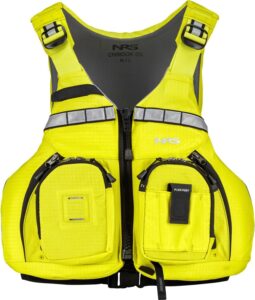
Why it’s here: NRS is one of the most established names in paddlesports, and the Chinook OS fishing vest is purpose-built for kayak/raft anglers rather than adapted from a general boating vest the pocket layout, rod holder, and high-back cut are all fishing-specific by design, and the six-point adjustment system makes it easy to dial in a secure fit over layers.
Specs (manufacturer-confirmed)
| Spec | Detail |
|---|---|
| USCG Rating | Type III, medium profile |
| Buoyancy | 16.0–16.5 pounds of buoyancy (NRS lists both figures across product lines) |
| Material | 400-denier ripstop nylon |
| Weight | ~2 lbs |
| MSRP / Street Price | $169.95 MSRP; commonly sold $110–170 |
Best for: Kayak anglers who want dedicated tackle storage, a rod holder loop, and a high-back panel built for raft or kayak seats the best choice if you fish more than you tour. Not ideal for: Paddlers who just want a minimal, lightweight vest for flatwater touring the fishing features add bulk you won’t use.
Pros
- High-back design built specifically for kayak/raft seats
- Six-point adjustment system plus fishing-specific pockets, rod holder, and knife lash tabs
- Durable ripstop material
Cons
- Premium price relative to non-fishing Type III vests
- Bulkier than minimalist paddling-only vests

- Perfect for kayak fishing, fly fishing and extended tours
- Back flotation panel conforms to an angler’s back, ensuring a flush fit
- Front zipper entry, plus adjustments on shoulders, side and waist secure the life jacket and provide a custom fit
2. Stearns Adult Classic Series Life Vest: Best Budget Life Jacket Pick
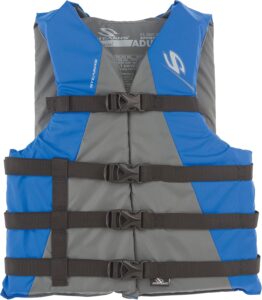
Why it’s here: This is Stearns’ long-running entry-level, affordable life jacket, backed by one of the largest verified review counts in the category (9,000+ ratings on major retail sites, averaging 4.6 stars) a strong reliability signal at a low price point and the best value pick for anyone who just needs a legal, comfortable-enough PFD on board.
Specs (manufacturer-confirmed)
| Spec | Detail |
|---|---|
| USCG Rating | Type III |
| Buoyancy | Not published as an exact figure; certified to Type III minimum standard |
| Material | Nylon shell, PE (polyethylene) flotation foam |
| Weight | ~2.1 lbs |
| Sizing | Universal adult, 30″–52″ chest (Oversize up to 60″) |
| MSRP / Street Price | $34.95 MSRP; frequently discounted to $20–30 |
Best for: New kayakers, casual paddlers, or a spare vest for guests who need a reliable, legal PFD without extra features. Not ideal for: Anglers or anyone wanting pockets, ventilation panels, or a contoured athletic fit this is a no-frills design.
Pros
- Lowest price point of any Coast Guard-approved vest on this list the best value for casual boating
- Simple, easy-to-adjust design with a front zipper you can manage one-handed
- Enormous, consistently positive review history
Cons
- Minimal ventilation compared to paddle-specific vests
- No pockets or fishing features
- Bulkier fit than premium foam designs

- US Coast Guard-approved adult life jacket
- Great for wakeboarding, water skiing, and tubing
- Soft and durable 200D nylon shell and lightweight PE flotation foam
3. Onyx MoveVent Dynamic Paddle Sports Life Vest: Best for Hot Weather
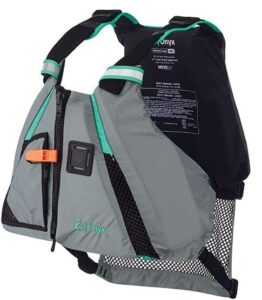
Why it’s here: Built with oversized armholes and front-and-back mesh ventilation channels specifically to reduce overheating, this is one of the more purpose-built hot/warm-weather paddle vests on the market, and reviewers specifically cite the high-back mesh panel as compatible with sit-on-top and high-back kayak seats.
Specs (manufacturer-confirmed)
| Spec | Detail |
|---|---|
| USCG Rating | Type III |
| Buoyancy | Not published as an exact figure; certified to Type III minimum standard |
| Material | 200-denier nylon ripstop and nylon oxford |
| Weight | ~1.1–1.3 lbs (varies by size) |
| MSRP / Street Price | $89.99 MSRP; commonly sold $62–85 |
Best for: Paddlers in warm climates or peak-summer conditions who prioritize airflow and a close, athletic fit. Not ideal for: Anglers needing storage this vest has just one expandable pocket, not a fishing-specific layout.
Pros
- Genuine front-and-back mesh ventilation, not just a lower-back panel
- Oversized armholes preserve full paddle-stroke mobility
- Mesh lower back specifically designed for high-back seats and sit-on-top kayaks
Cons
- Minimal storage one pocket only
- Some buyers report sizing runs large; check the chest-inch chart closely before ordering

- Mesh in lower back fits high back seats. Applies to Onyx MoveVent Dynamic Paddle Sports Life Vest.
- Shoulder adjustments with neoprene comfort pads. Applies to Onyx MoveVent Dynamic Paddle Sports Life Vest.
- Six adjustment straps to cinch vest up for a snug fit. Applies to ONYX Kayak Fishing Life Jacket.
4. O’Neill Women’s Superlite Life Vest: Best for Women
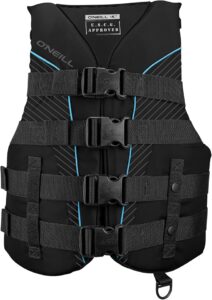
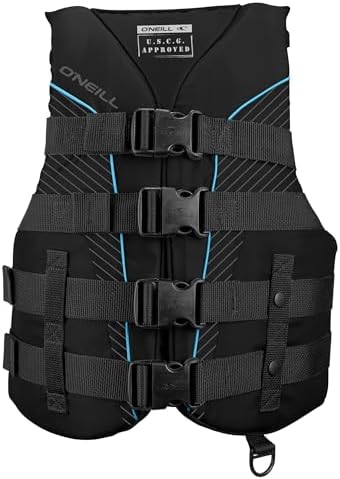
Why it’s here: This is O’Neill’s dedicated women’s-fit vest, with a contoured cut and relaxed sizing built around female body proportions rather than a scaled-down men’s pattern. Worth noting up front: it’s marketed primarily as a wake-sports/water-ski vest, not a kayak-specific model but its lightweight, low-bulk Type III design and strategic armhole cut make it a solid crossover choice for paddling.
Specs (manufacturer-confirmed)
| Spec | Detail |
|---|---|
| USCG Rating | Type III |
| Buoyancy | Not published as an exact figure; certified to Type III minimum standard |
| Material | Coated polyester shell, lightweight polyethylene foam |
| Weight | ~1 lb |
| MSRP / Street Price | $49.95 MSRP; commonly sold $40–57 |
Best for: Women who find unisex vests fit poorly through the torso and want a lighter, more contoured option for general paddling and water sports. Not ideal for: Kayak anglers wanting a high-back panel or storage pockets this vest doesn’t include either.
Pros
- Strategic armhole sizing and relaxed cut designed for a wider range of body types
- Lightweight, low-bulk construction
- Quick-release quad safety buckles for fast adjustment
Cons
- Not purpose-built for kayaking specifically no dedicated high-back or fishing features
- Some buyers report it runs small; check size chart before ordering (see review note in Sizing section above)
5. Onyx Kayak Fishing Life Jacket Best High-Back for Kayak Seats
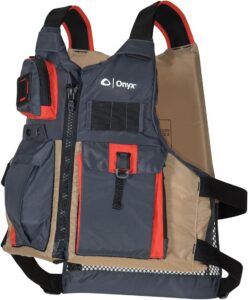
Why it’s here: This model carries one of the largest verified review counts of any kayak fishing PFD we found several thousand ratings at a 4.5+ average across retailers. That volume is a meaningful reliability signal, though “top-selling” rankings shift over time and we’d recommend re-checking current Best Sellers Rank on Amazon before publishing. Its defining feature is a high foam back panel purpose-built to sit above a kayak seat back, paired with a breathable mesh lower back so it doesn’t trap heat against the seat.
Specs (manufacturer-confirmed)
| Spec | Detail |
|---|---|
| USCG Rating | Type III (USCG and Transport Canada approved) |
| Buoyancy | Not published as an exact figure; certified to Type III minimum standard |
| Material | 400-denier nylon oxford |
| Weight | ~1.3 lbs |
| MSRP / Street Price | Commonly sold $75–95 depending on retailer/size |
Best for: Kayak anglers who specifically need the vest to clear a high-back fishing kayak seat without bunching, plus tackle storage. Not ideal for: Paddlers in sit-inside touring kayaks with low seat backs, where the high-back design offers no functional benefit and adds unnecessary bulk.
Pros
- Purpose-built high-back design that clears kayak seat backs cleanly
- Four distinct pocket/storage configurations, including a drop-down tackle tray pocket
- Six adjustment straps for a dialed-in, secure fit
- Very large, consistently positive review base (thousands of ratings, 4.5+ average across retailers)
Cons
- Several reviewers note it runs slightly large consider sizing down if between sizes
- Less streamlined than minimalist touring vests

- Designed for Anglers – Multiple pockets and tool holders keep fishing gear within easy reach
- Ultimate Comfort – High-back design works with kayak seats, while adjustable straps ensure a perfect fit
- Maximum Safety – U.S. Coast Guard Approved PFD provides reliable flotation for fishing and paddling
6. Onyx A/M-24 Inflatable Life Jacket Best Inflatable
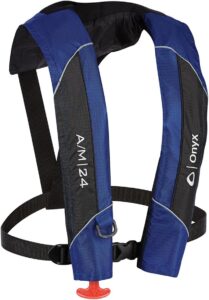
Why it’s here: For experienced paddlers who prioritize minimal bulk, the A/M-24 stays compact until inflated either automatically on water contact or manually via pull cord then delivers meaningfully more buoyancy than a standard foam vest.
Important classification note: This is officially certified as a “USCG-approved Type V life jacket with Type III performance.” In plain terms: it falls under the Type V special-use category (as most inflatables do), but once inflated it meets Type III’s continuous-support performance standard. As with any Type V device, it only counts toward legal carriage requirements while being actively worn not simply stored on board.
Specs (manufacturer-confirmed)
| Spec | Detail |
|---|---|
| USCG Rating | Type V (Type III performance when inflated) |
| Buoyancy | 22.5 lbs when inflated |
| Inflation | Automatic (water-activated) and manual pull-cord, convertible to manual-only |
| Material | Nylon shell, soft neoprene neckline |
| Minimum User | 16+ years old, 80+ lbs, not recommended for non-swimmers |
| MSRP / Street Price | $209 MSRP; commonly sold $98–170 |
Best for: Confident swimmers doing calm-water fishing, touring, or paddling who want maximum freedom of movement and don’t mind the added maintenance. Not ideal for: Whitewater paddling, non-swimmers, or weak swimmers the manufacturer explicitly advises against this use case.
Pros
- Minimal bulk and maximum freedom of movement when uninflated
- Higher buoyancy once deployed (22.5 lbs) than any foam Type III vest on this list
- Convertible between automatic and manual-only inflation modes
Cons
- Requires a CO2 rearming kit (sold separately) after each deployment
- Not recommended for whitewater or non-swimmers per manufacturer guidance
- Must be actively worn not just carried to satisfy legal requirements

- U.S. COAST GUARD APPROVED: This USCG-approved Inflatable Life Jacket inflates automatically upon water immersion or manu…
- HIGHLY BUOYANT: Provides 22.5 pounds of buoyancy when fully inflated, keeping you safe and afloat. Its buoyant material …
- MANUAL INFLATION OPTION: Easily converts to MANUAL ONLY inflation mode when paddling, fly-fishing, or other activities w…
7. Stearns Kids Life Vest Best Youth Life Jacket
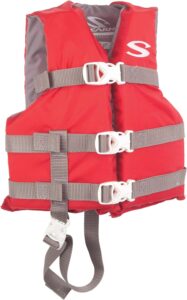
Why it’s here: A straightforward, budget-friendly youth vest sized for kids 50–90 lbs, prioritizing visibility and a secure, non-riding-up fit for family kayaking trips.
Specs (manufacturer-confirmed)
| Spec | Detail |
|---|---|
| USCG Rating | Type III |
| Buoyancy | Not published as an exact figure by Stearns for this line; certified to Type III minimum standard |
| Weight Range | 50–90 lbs (youth) |
| Material | Nylon shell, PE foam |
| MSRP / Street Price | Commonly sold $20–35 |
Best for: Parents outfitting kids specifically in the 50–90 lb range for calm-water family paddling. Not ideal for: Kids under 50 lbs they need a Child (30–50 lb) or Infant (8–30 lb) size instead; never size up “for room to grow” (see Common Buying Mistakes below).
Pros
- Bright, high-visibility colors
- Simple, parent-friendly adjustable buckles
- Budget-friendly
Cons
- Narrow weight range verify your child’s current weight, not projected weight, before buying
- Basic feature set (no storage, minimal ventilation)

- US Coast Guard-Approved: For optimum water safety
- Perfectly Fitted: Designed for children weighing between 30 to 50 pounds
- Durable Materials: Features a tough nylon shell with PE flotation foam
Other Kayak PFDs Worth a Look
The seven picks above cover the main use cases, but a few other models and features are worth knowing about as you shop:
- NRS Ninja PFD: A lower-profile, more affordable sibling to the Chinook from the same brand worth comparing if you want NRS’s fit quality without the full fishing feature set.
- Clamshell pocket designs: Some fishing-specific vests use a clamshell pocket (a hinged, hard-shell front pocket) instead of soft zippered pockets useful for pliers and tools you want to grab without looking.
- Paddle board and canoe compatibility: Most of the vests above, especially the ventilated and high-back designs, work equally well if you also paddle board or canoe the shorter torso and mesh back that help in a kayak seat translate directly to SUP and canoe use.
- General water sports vests: If you already own a water sports vest for wakeboarding or skiing, it may be Coast Guard-approved and legal to use kayaking, but check the fit against the kayak-specific notes above general water sports cuts often don’t account for a seated paddling position.
- Life jackets for dogs: If you paddle with a dog, a properly fitted dog life jacket with a top grab handle is worth adding to your gear list the same “if it doesn’t fit, it won’t work” logic applies to pets as much as people.
- What’s newer on the market: Newer life jackets increasingly favor mesh ventilation panels and shorter, more athletic cuts built specifically for seated paddling, a shift away from the bulkier, general-purpose boating vests of a decade ago.
Common Buying Mistakes to Avoid
- Sizing a kid’s vest “for growth.” A loose life vest on a child will ride up and can slip off entirely in the water. Always size to current weight, never anticipated future weight.
- Assuming any PFD is fine for kayaking. General boating vests often ride up badly in a seated paddling position and can dig into your neck or shoulders on every stroke. Buy paddle-sport-specific when possible.
- Ignoring the back panel design. If you kayak fish or use a sit-on-top with a high seat back, a standard low-back PFD will bunch up uncomfortably check for a high-back or mesh-back design first.
- Buying an inflatable for whitewater or as a non-swimmer. Manufacturers explicitly advise against this; inflatables are built for calm-water use by confident swimmers.
- Skipping the fit test after purchase. A vest that looks right on the hanger can still ride up badly on your specific body always do the shoulder-pull test (see FAQ) before relying on it.
- Not checking your state’s specific requirements. Some states require the PFD to be worn (not just carried) for kayaks and paddlecraft specifically, regardless of the federal minimum rules vary, so check your state boating authority.
PFD Maintenance and Care
A life jacket is safety equipment treat it like it matters:
- Rinse after every use, especially in saltwater, to prevent salt buildup that degrades material and buckles over time.
- Air dry fully before storage; never store a damp PFD in a sealed bag or hatch, which encourages mold and mildew.
- Inspect before every season (and ideally before every trip): check for torn seams, cracked or brittle foam, broken buckles, and faded/illegible USCG labeling.
- For inflatables specifically: check the CO2 cartridge and indicator window before each outing to confirm it’s armed, and always carry a spare rearming kit if you paddle regularly.
- Replace, don’t repair, compromised foam. If foam feels flattened, crumbly, or significantly less buoyant than when new, its flotation performance has likely degraded replace the vest rather than trusting it.
- Store away from direct sunlight and heat (not in a hot car trunk or closed vehicle) UV and heat both accelerate material breakdown.
FAQs About Kayak Life Jackets
Type III vs. Type V: What’s the Difference?
A Type III PFD is designed for constant, comfortable wear the standard choice for kayaking, fishing, and general paddle sports, offering roughly 15.5–16.5 lbs of buoyancy with full range of motion. Type V is a special-use category that covers a wider range of devices some inflatables, but also non-inflatable items like whitewater rescue vests and commercial work vests. A Type V device must be worn exactly as labeled to count toward Coast Guard carriage requirements; check the specific label, since Type V devices vary more in performance than Type III does.
Are All Inflatable Life Jackets Type V?
Not necessarily by function, though most are classified that way. Some inflatables (like the Onyx A/M-24 above) are certified as “Type V with Type III performance” meaning once inflated, they meet the continuous-support standard of a Type III vest, even though they’re categorized as Type V. Always check the specific device’s label rather than assuming based on “inflatable” alone.
Life Jacket or PFD: What’s the Difference?
There isn’t one “life jacket” and “PFD” (personal flotation device) are used interchangeably in everyday language and largely interchangeably by the Coast Guard too. “PFD” is the more precise umbrella term covering all five official types, while “life jacket” is the common name people use for wearable Type II/III/V devices specifically. You’ll see both terms throughout this guide referring to the same category of gear.
What Are Coast Guard Life Jacket Requirements for Kayaks?
At minimum, federal rule requires one wearable, appropriately sized, Coast Guard-approved life jacket on board for every person in the kayak. Many states go further and require it to be actively worn on certain waterways, in cold water, or by children under a specific age those rules vary significantly by state, so check your local boating authority alongside the U.S. Coast Guard’s official guidance.
What’s the Difference Between a Fishing Vest and a Fishing Life Jacket?
A standard fishing vest (the kind anglers wear on shore or from a dock) is built purely for gear storage and has no flotation value at all. A fishing life jacket like the NRS Chinook or Onyx Kayak Fishing Life Jacket above combines that same pocket-heavy storage with Coast Guard-certified Type III buoyancy, so it functions as both your tackle storage and your safety gear at once. For kayak fishing specifically, always choose the life jacket version, not a plain fishing vest.
Can I Use My Kayak Life Jacket for Canoeing or Other Water Sports?
Generally, yes. A Type III kayak PFD is rated for paddle sports broadly, so it works fine for canoeing and is often comfortable enough for other water sports too, as long as the fit is snug and secure. The reverse isn’t always true, though a vest designed for wakeboarding or waterskiing may not have the high-back or torso-length adjustments that make a seated kayaking position comfortable for hours.
How Should a PFD Fit?
It should fit snugly, almost like a firm hug, without restricting your paddle stroke. A simple fit test: have someone gently pull up on the shoulder straps while you’re wearing it fully zipped and cinched. If it rides up significantly toward your ears, it’s too loose and needs tightening or a smaller size. There should be no major gaps around the armholes or waist, and for kayakers specifically the lower back shouldn’t bunch against your seat.
Inflatable vs. Foam: Which Is Better for Kayaking?
Foam (typically Type III) vests provide constant, no-action-required buoyancy and are the safer default for whitewater, new paddlers, and non-swimmers. Inflatable vests offer more comfort and mobility for experienced paddlers on calm water, but require maintenance (rearming kits) and aren’t recommended for rough conditions or anyone who isn’t a confident swimmer.
Is It Legal to Kayak Without a Life Jacket?
Requirements vary by state, but in most U.S. states, a wearable, Coast Guard-approved PFD of the appropriate size is legally required to be on board for every person in a kayak some states also mandate it be worn, particularly for children or in certain water conditions. Check your specific state’s boating authority for exact requirements, and refer to the U.S. Coast Guard’s official guidance for the federal baseline.
How Do I Know What Size PFD I Need?
Measure your chest at its fullest point and compare it to the specific model’s size chart sizing is brand-specific and doesn’t carry over. For kids, size by current body weight, not age or height.
Final Thoughts: Finding Your Favorite Life Jacket for Kayaking
The best life jacket is the one you’ll actually wear every time you’re on the water comfort and fit matter as much as buoyancy rating. A great life jacket is one you genuinely forget you’re wearing after the first ten minutes, which is exactly the goal: a Type III device is designed to keep a conscious swimmer face-up with minimal effort, but only if it’s on your body, not in your hatch.
For most paddlers, a vest with a high-back, kayak-seat-compatible design (like the Onyx Kayak Fishing Life Jacket or NRS Chinook) strikes the best balance of safety, comfort, and function for staying comfortable in a kayak seat through a full day of sitting in a kayak. Anglers should lean toward storage-heavy options; hot-climate paddlers should prioritize ventilation; and anyone paddling calm water solo should weigh whether an inflatable’s comfort trade-off is worth the added maintenance.
Every paddler needs a life jacket that fits correctly that’s the one consistent finding across manufacturers, reviewers, and Coast Guard guidance alike. Wearing life vests consistently, not just keeping one on board, is what actually protects you and gives parents peace of mind on family trips. Whatever you choose, always confirm current Coast Guard approval on the label, check the manufacturer’s specific sizing chart, and pair it with the right boat see our guides on choosing your first kayak and what size kayak you need if you’re still building out your setup.