If you’re shopping for a pedal-powered fishing kayak, you already know the frustration: dozens of “best of” lists, wildly different prices, and specs that don’t line up from one site to the next. This guide compares 7 of the best pedal kayaks for fishing on the market, based on verified manufacturer specifications and cross-checked retailer listings with honest pros, cons, and pricing so you can choose the best kayak for fishing without guesswork.
Source Transparency & Methodology: How We Chose the Best Pedal Drive Fishing Kayaks
How this guide was put together: Every spec in this article length, weight, capacity, drive type, warranty terms was cross-checked against at least one manufacturer source or verified retailer listing (Amazon, Bass Pro Shops, Dick’s Sporting Goods, or the manufacturer’s own site) as of the last-updated date above. Where sources disagreed slightly (e.g., rounded vs. exact measurements), we used the manufacturer’s own published figure.
What this guide is not: This is a research-based comparison, not a hands-on, side-by-side field test of all 7 kayaks. We have not personally paddled and pedaled each of these boats back to back. Where we reference on-water impressions, they’re drawn from aggregated, publicly available owner reviews (Paddling.com, retailer review sections, manufacturer forums) not our own testing and we’ve said so explicitly rather than implying otherwise.
If you want first-hand field-test data, outlets like Paddling.com and paddlingspace.com conduct hands-on reviews of individual models, and we’d recommend cross-referencing those alongside this guide.
Specs and pricing change. Manufacturers update models, colorways, and pricing throughout the year. Treat the prices below as a recent range, not a live quote always confirm current price and stock on the retailer’s listing before buying.
Quick Picks
If you don’t have time to read the full breakdown, here’s the short version:
- 🏆 Best Overall: Old Town Sportsman BigWater PDL 132 the most balanced all-rounder for stability, speed, and warranty coverage
- 💰 Best Budget: Perception Pescador Pilot 12 the cheapest way into a real pedal drive system
- 🔰 Best for Beginners: Pelican Catch 110 HDII lightest, simplest, easiest to learn on
- 🐘 Best High-Capacity: Hobie Mirage Pro Angler 14 with 360 Drive 600 lb capacity and true 360° maneuverability
- 🪶 Best Lightweight: Hobie Mirage Passport 10.5 75 lbs fully rigged, easiest to car-top solo
- ⚖️ Best Value: Native Watercraft Titan Propel 13.5 big-boat stability and features below flagship pricing
- ⚡ Best Premium: Old Town Sportsman BigWater ePDL+ 132 power-assisted pedal drive with motorized cruise mode
Introduction to Pedal Drive Fishing Kayaks
Pedal drive fishing kayaks have changed how serious anglers approach the water. Instead of alternating a paddle with a fishing rod, a pedal system frees your hands completely so you can cast, reel, and manage gear while your legs handle propulsion.
What is a pedal drive fishing kayak? It’s a sit-on-top kayak fitted with a mechanical pedal system typically a propeller (like Native Watercraft’s Propel Drive) or oscillating fins (like Hobie’s MirageDrive) that converts leg power into forward or reverse motion. Pedaling to propel the kayak leaves your hands completely free, which is the core appeal for anglers over a standard paddle kayak.
Why choose pedal over paddle? Pedal drives let you cover more distance with less fatigue, hold a position against wind or current without dropping your rod, and fish continuously instead of stopping to paddle. The tradeoff: pedal kayaks are heavier, pricier, and have more moving parts to maintain than a simple paddle kayak.
What Makes a Pedal-Powered Fishing Kayak Different From a Standard Fishing Boat?
A pedal-powered fishing kayak trades an outboard or trolling motor for human-powered pedal propulsion no fuel, no registration hassles in most states, and a far lower cost of entry than a traditional fishing boat. For a kayak fisherman who fishes shallow flats, small lakes, or tight backwater, that tradeoff usually favors the kayak: quieter approach, easier launching, and the ability to fish water a larger boat simply can’t reach. Larger anglers or those covering big, open water on a regular basis may still prefer a full-size fishing boat pedal propulsion has real limits on range and speed compared to a motor.
Comparison Table: 7 Best Pedal Drive Fishing Kayaks for 2026
| Kayak | Length | Fully Rigged Weight | Capacity | Drive System | Hull/Drive Warranty | Price Range* | Best For |
|---|---|---|---|---|---|---|---|
| Old Town Sportsman BigWater PDL 132 | 13’2″ | ~117 lbs (96 lb hull + drive/seat) | 500 lbs | Old Town PDL (forward/reverse) | Lifetime hull / 5-yr drive | $2,700–$3,100 | Best Overall |
| Perception Pescador Pilot 12 | 12’5″ | 85 lbs | 475 lbs | Pilot Drive (propeller, reverse) | 5-yr hull & deck / 1-yr parts | $1,600–$1,900 | Best Budget |
| Pelican Catch 110 HDII | 10’6″ | 67 lbs | 350 lbs | HyDryve II (rudder-controlled) | Lifetime limited | $1,000–$1,300 | Best for Beginners |
| Hobie Mirage Pro Angler 14 (360 Drive) | 13’8″ | 144.5 lbs | 600 lbs | MirageDrive 360 w/ Kick-Up Fins | 2-yr hull & components | $4,800–$5,800** | Best High-Capacity |
| Hobie Mirage Passport 10.5 | 10’6″ | 75 lbs | 325 lbs | MirageDrive GT | 2-yr hull & components | $1,900–$2,300** | Best Lightweight |
| Native Watercraft Titan Propel 13.5 | 13’6″ | 178 lbs | 550 lbs | Propel Pedal Drive (forward/reverse) | 5-yr hull | $2,800–$3,300 | Best Value |
| Old Town Sportsman BigWater ePDL+ 132 | 13’2″ | ~130+ lbs (with battery) | 500 lbs | ePDL+ (power-assisted pedal + motor) | Lifetime hull / 5-yr drive | $4,200–$4,800 | Best Premium |
Prices fluctuate by retailer, color/camo pattern, and included accessories. Confirm current pricing on the live listing before publishing or purchasing. *Hobie kayaks are sold primarily through Hobie.com and authorized dealers rather than direct Amazon listings confirm price and stock through those channels.
Seat, Storage & Fishing-Feature Comparison
Beyond the headline specs, day-to-day comfort and rigging options often decide which kayak actually gets used. Here’s how the 7 compare on the details that matter most on the water:
| Kayak | Seat Type | Rod Holders | Standout Storage | Notable Rigging |
|---|---|---|---|---|
| Old Town BigWater PDL 132 | Adjustable mesh seat, lumbar support, shuttle track | 3 flush-mount | Bow hatch, Plano tackle box included | 2 forward + 2 stern accessory tracks, transducer mount |
| Perception Pescador Pilot 12 | Adjustable captain’s chair, zonal mesh, on-the-fly recline (no high/low position) | 4 molded-in | Bow tankwell, stern tankwell w/ scupper lid | 2 YakAttack gear tracks, transducer scupper |
| Pelican Catch 110 HDII | Ergocast G2, adjustable firmness, flips back for standing room | 3 flush-mount | 8″ day hatch w/ storage bag, 2 tank wells | 4 accessory rails, angler ruler |
| Hobie Pro Angler 14 (360) | Vantage seat, BOA lumbar support, elevated | 6 (horizontal + flush) | Large front hatch w/ removable liner, 2 Flambeau tackle boxes included | 12-sided H-Rail system, Guardian retractable transducer shield |
| Hobie Passport 10.5 | Suspended mesh aluminum frame seat | 2 | 8″ Twist-n-Seal hatch | 2 accessory mounting tracks, vertical accessory tube |
| Native Titan Propel 13.5 | “First Class” elevated seat, slides fore/aft, moves for walk-around deck | Horizontal (rod-tip protected) | Oversized bow dry hatch, large stern well, under-seat tray | Bow-to-stern rail system (~26 ft of track), 2 Power-Pole mounts |
| Old Town ePDL+ 132 | Same adjustable mesh seat as BigWater PDL | 3 flush-mount | Bow hatch, Plano tackle box included | Same track layout as BigWater PDL, plus battery/motor wiring |
Other Popular Pedal-Powered Fishing Kayaks Worth Considering
The seven kayaks above cover the strongest all-around picks, but they aren’t the only stable kayaks on the market worth a look. A few other popular kayaks come up often in kayak angler communities and buying guides like Kayak Angler Magazine’s buyer’s guide:
- Wilderness Systems ATAK / Radar (Helix PD Pedal Drive): Wilderness Systems’ Helix PD™ pedal drive is a well-regarded propeller system, and models like the Radar 115 compete directly with the Old Town and Native options on this list for stability and rigging space.
- 3 Waters Kayaks Big Fish Series: A budget-to-mid-range line that competes with the Perception Pescador Pilot and Pelican Catch on price, with a loyal following among bass and panfish anglers.
- Old Town Predator PDL: The predecessor to the BigWater PDL 132 still sold in some markets and worth checking if you find one at a discount, though the BigWater PDL 132 supersedes it with updated seating and storage.
A note on inflatable and tandem pedal kayaks: If portability is your top priority, a handful of manufacturers now offer inflatable fishing kayak options with add-on pedal drives, though they generally can’t match a hardshell hull’s stability or top speed worth considering only if storage space is your primary constraint. True two-person tandem pedal kayaks are rare in the pedal-drive category; most tandem kayak options on the market are paddle-only, since dual pedal-drive systems add significant cost and complexity.
The 7 Best Pedal Kayaks for Fishing, Reviewed
1. Best Overall: Old Town Sportsman BigWater PDL 132
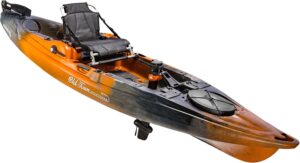
The Old Town Sportsman BigWater PDL 132 is a strong all-around choice for anglers who want stability, efficient pedal propulsion, and plenty of capacity. Its PDL Drive provides forward and reverse control, making it easier to adjust your position while fishing. The 13’2″ hull and 500-pound capacity make it suitable for larger loads and open-water fishing. The removable drive also helps with transportation and storage. However, its fully rigged weight can make solo loading difficult, and it costs more than budget-oriented models. Overall, it is best suited to anglers who prioritize stability, fishing functionality, and versatile performance.
Specifications
| Spec | Detail |
|---|---|
| Length | 13’2″ |
| Width | 36″ |
| Hull weight | 96 lbs |
| Fully rigged weight | ~117 lbs (hull + drive + seat) |
| Capacity | 500 lbs |
| Drive system | Old Town PDL (forward/reverse), removable |
| Seat | Adjustable mesh seat, lumbar support, shuttle track |
| Rod holders | 3 flush-mount |
| Warranty | Lifetime limited (hull/deck); 5-year limited (PDL Drive); 1-year (accessories) |
| Availability | Amazon.com and major outdoor retailers |
Pros & Cons
| Pros | Cons |
|---|---|
| Instant forward/reverse for precise positioning | Heavy to load solo most owners use a cart, trailer, or second person |
| Strong stability platform for standing and casting | Mid-to-upper price range |
| Best-in-class warranty (lifetime hull, 5-year drive) | Some owners report drive maintenance needed in sandy/silty water |
| Removable drive simplifies transport and storage | Not the lightest option for small vehicles |
Buy If:
- You want one kayak that handles lakes, rivers, and coastal water without major compromise
- You value best-in-class warranty coverage
- You plan to stand and cast regularly
Skip If:
- You need to load the kayak onto a roof rack solo at ~117 lbs fully rigged, most owners recommend a cart or trailer, or a second person to help load
- You’re on a tight budget this sits mid-to-upper range on price
Verdict: The strongest all-around pick on this list, backed by the best warranty terms of any kayak here. The main tradeoff is weight and price, not performance.

- Ideal for open water anglers and tournament fishing pros, the Old Town Sportsman BigWater PDL 132 pedal kayak’s easy-to-…
- All Old Town Sportsman fishing kayaks are packed with handy convenience features, including customizable accessory track…
- The kayak’s universal transducer mounting system makes it easy to mount your favorite fish finder (sold separately), and…
2. Best Budget Option: Perception Pescador Pilot 12
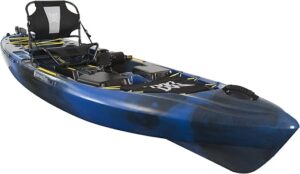
The Perception Pescador Pilot 12 is an affordable entry point for anglers who want pedal-drive fishing without moving into premium pricing. Its Pilot Drive uses a propeller-based system with forward and reverse capability, while the removable design makes transportation and setup easier. With a 12-foot length and approximately 475-pound capacity, it offers useful space for fishing gear and accessories. Multiple rod holders and accessory tracks add practical value for anglers building a fishing setup. Its main drawbacks include less standing stability than wider competitors and reported concerns about long-term component wear and customer service. It is best suited to budget-conscious anglers.
Specifications
| Spec | Detail |
|---|---|
| Length | 12’5″ |
| Width | 33.75″ |
| Boat weight | 85 lbs |
| Deck height | 16″ |
| Capacity | 475 lbs |
| Drive system | Pilot Drive (propeller, forward/reverse), removable |
| Seat | Adjustable captain’s chair, zonal mesh, fixed height (no high/low) |
| Rod holders | 4 molded-in |
| Warranty | 5-year limited (hull/deck); 1-year (parts, accessories, outfitting) |
| Availability | Amazon.com |
Pros & Cons
| Pros | Cons |
|---|---|
| Lowest entry price for a genuine pedal drive system | Fixed-height seat no high/low adjustment |
| Lightweight, removable Pilot Drive | Some owners report slow warranty/customer service turnaround |
| 4 rod holders and 2 gear tracks included | Narrower hull than tunnel-hull competitors less standing stability |
| Made in the USA | Rudder cable and prop are wear items some owners have had to replace |
Buy If:
- You want to try pedal fishing without a $2,500+ commitment
- You mostly fish calm-to-moderate water
- You’re comfortable performing basic DIY maintenance if needed
Skip If:
- You need a high/low seat adjustment the Pescador’s seat is fixed-height only
- You want top-tier customer service responsiveness some owners report slow warranty/support turnaround, which is worth researching current sentiment on before buying
- You’re a larger-frame angler needing max stability for standing casts narrower hull than the tunnel-hull options on this list
Verdict: The best entry point if price is your top constraint. Real value, real tradeoffs go in knowing the seat and standing stability are basic compared to pricier options.

- Pedal Drive Efficiency: The Perception Pescador Pilot 12 offers a unique pedal drive system for sit-on-top kayaks. This …
- Comfort and Convenience: Fitted with an adjustable frame seat, it ensures optimal comfort for lengthy fishing adventures…
- High Capacity and Durable: With an impressive maximum capacity of 475 lbs, this kayak comfortably supports various paddl…
3. Best for Beginners: Pelican Catch 110 HDII
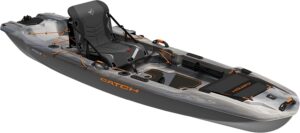
The Pelican Catch 110 HDII is designed for anglers who want a compact and relatively easy-to-transport pedal fishing kayak. At 10’6″ and around 67 pounds, it is the lightest model in this comparison, making solo car-topping and launching more manageable. Its HyDryve II system and tunnel hull provide a beginner-friendly combination of pedal propulsion and stability. The 350-pound capacity is its biggest limitation, particularly for heavier anglers or those carrying substantial fishing equipment. Some reported deck flex and rudder play may also matter to demanding users. For beginners fishing smaller lakes, ponds, and calm rivers, it offers an accessible starting point.
Specifications
| Spec | Detail |
|---|---|
| Length | 10’6″ (126″) |
| Width | 34″ |
| Weight | 67 lbs |
| Capacity | 350 lbs |
| Drive system | HyDryve II (rudder-controlled) |
| Seat | Ergocast G2, adjustable firmness, flips back for standing room |
| Rod holders | 3 flush-mount |
| Warranty | Manufacturer’s lifetime limited warranty |
| Availability | Amazon.com, Bass Pro Shops, Dick’s Sporting Goods, Academy |
Pros & Cons
| Pros | Cons |
|---|---|
| Lightest kayak on this list easiest solo car-topping | Lowest weight capacity on this list (350 lbs) |
| Lifetime limited warranty | Some owner reviews note deck flex under heavier loads |
| Tunnel hull adds stability for its compact size | Rudder steering has more play than direct-drive systems |
| Lower price point low-risk entry into pedal fishing | Fewer rod holders/tracks than larger kayaks on this list |
Buy If:
- You’re new to kayak fishing and want the lightest, most forgiving option
- You transport solo without a trailer
- You mainly fish ponds, small lakes, and calm rivers
Skip If:
- You need to carry a heavier gear load or run a lot of electronics 350 lb capacity is the lowest on this list
- You want the crispest, most direct steering some owners report noticeable play in the rudder steering compared to Old Town’s PDL
- You want a flex-free deck under heavier loads a few owner reviews note deck flex compared to stiffer hulls
Verdict: The easiest kayak on this list to buy, transport, and learn on the right call for most true beginners, as long as your gear load stays modest.

- STABLE: The tunnel hull offers maximum stability for a secure and steady ride. It also makes it incredibly easy to get i…
- COMFORTABLE: The ERGOBOOST seating system is one of our most comfortable fishing chairs. It’s adjustable to allow a high…
- PREMIUM FISHING FEATURES: This fishing kayak comes equipped with two 4″ rigging tracks to set up your accessories. Bring…
4. Best High-Capacity: Hobie Mirage Pro Angler 14 with 360 Drive
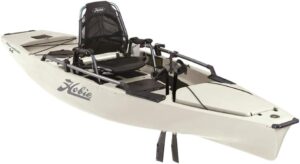
The Hobie Mirage Pro Angler 14 with 360 Drive is built for anglers who need maximum capacity, stability, and advanced maneuverability. Its 13’8″ hull supports up to 600 pounds, providing substantial room for fishing equipment and longer trips.
The MirageDrive 360 with Kick-Up Fins allows omnidirectional movement, including turning and sideways positioning, giving anglers precise control around fishing spots. Its major downside is cost, as it sits well above the other models in this comparison. It is also sold primarily through Hobie and authorized dealers rather than Amazon. This kayak is best for experienced anglers carrying heavy loads and prioritizing advanced control.
Specifications
| Spec | Detail |
|---|---|
| Length | 13’8″ |
| Fitted hull weight | 120.5 lbs |
| Fully rigged weight | 144.5 lbs |
| Capacity | 600 lbs |
| Drive system | MirageDrive 360 with Kick-Up Fins (omnidirectional) |
| Seat | Vantage seat, BOA lumbar support, elevated |
| Rod holders | 6 (horizontal + flush-mount) |
| Warranty | 2-year coverage on hull and all components |
| Availability | Hobie.com and authorized dealers not typically listed on Amazon |
Pros & Cons
| Pros | Cons |
|---|---|
| Highest capacity on this list (600 lbs) | Most expensive kayak on this list by a wide margin |
| True 360° maneuverability unique among drives here | Fins need more post-impact inspection than propeller drives |
| 6 rod holders and extensive H-Rail mounting system | Not sold on Amazon requires a dealer purchase |
| Strong brand reputation for durability | Shorter warranty (2 yrs) than Old Town’s lifetime hull coverage |
Buy If:
- You need maximum capacity for multi-day trips or heavy electronics loads
- True 360° maneuverability matters for your fishing style (sight casting, tight spots)
- You’re comfortable buying through a dealer rather than Amazon
Skip If:
- Budget is a primary concern this is the most expensive kayak on the list by a wide margin
- You want the simplest drive to maintain fins require more inspection after impacts than propeller drives
- You want one-click online ordering expect a dealer conversation, not an instant checkout
Verdict: The most capable and maneuverable kayak here, at the highest price and with the least purchasing convenience. Worth it if you fish seriously and often.

- Equipped with the powerful Hobie Mirage Drive 180 with Turbo Fins and a retractable rudder system
- Vantage Seating provides the ultimate comfort control with 4-way adjustability and Boa lumbar support
- 2 vertical rod holders, 6 horizontal rod holders; Two Piece Paddle and T-Handle
5. Best Lightweight: Hobie Mirage Passport 10.5
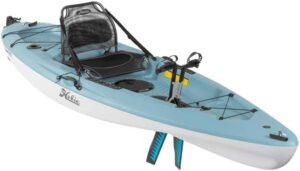
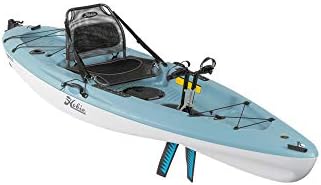
The Hobie Mirage Passport 10.5 combines Hobie’s pedal-drive system with a smaller, more transport-friendly kayak design. Measuring 10’6″ and offering a 325-pound capacity, it is suited to anglers who prioritize portability and fish smaller bodies of water.
Its MirageDrive GT provides efficient pedal propulsion, while the compact hull is easier to manage than many larger fishing kayaks. The lower 325-pound capacity limits how much equipment and gear you can carry, and its smaller hull provides less standing stability than larger models. It also carries premium Hobie pricing. For solo anglers who frequently transport their kayak and fish ponds, smaller lakes, or rivers, it is a practical option.
Specifications
| Spec | Detail |
|---|---|
| Length | 10’6″ |
| Width | 34″ |
| Fitted hull weight | 65 lbs |
| Fully rigged weight | 75 lbs |
| Capacity | 325 lbs |
| Drive system | MirageDrive GT with Kick-Up Fins |
| Seat | Suspended mesh aluminum frame seat |
| Rod holders | 2 |
| Warranty | 2-year coverage on hull and all components |
| Availability | Hobie.com and authorized dealers not consistently listed on Amazon |
Pros & Cons
| Pros | Cons |
|---|---|
| Lightest, easiest-to-transport kayak on this list | Lowest capacity on this list (325 lbs) |
| Hobie’s drive reputation at the brand’s lowest price point | Smaller hull means less standing stability than larger models |
| Compact size suits ponds, small lakes, and rivers | Only 2 rod holders fewer than most others on this list |
| Includes a paddle standard | Not sold on Amazon dealer purchase required |
Buy If:
- You fish solo and need to car-top without help
- You mostly fish small lakes, ponds, and slow rivers
- You want Hobie’s drive reputation at the brand’s lowest price point
Skip If:
- You need to carry a heavy gear or electronics load 325 lb capacity is the lowest on this list
- You want maximum standing stability smaller hull than the 13’+ options here
- You want Amazon convenience same dealer-network caveat as the Pro Angler above
Verdict: The easiest-to-transport kayak on this list. A strong pick for solo anglers on smaller water, less so for big-water, heavy-gear trips.
6. Best Value: Native Watercraft Titan Propel 13.5
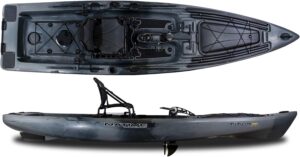
The Native Watercraft Titan Propel 13.5 combines a wide, stable hull with Native’s Propel Pedal Drive, making it a strong option for anglers who want a substantial fishing platform without choosing the highest-priced model. Its 13’5″ length and approximately 550-pound capacity provide plenty of room for an angler, fishing equipment, and accessories. The Propel system offers forward and reverse control, while the elevated seating design supports easier transitions between sitting and standing. Its main disadvantages are weight and transportation difficulty, particularly for solo users, along with a smaller dealer and accessory network in some areas. It is best suited to anglers who value stability, capacity, and overall value.
Specifications
| Spec | Detail |
|---|---|
| Length | 13’6″ |
| Width | 41.5″ |
| Fully rigged weight | 178 lbs |
| Capacity | 550 lbs |
| Drive system | Native Watercraft Propel Pedal Drive (forward/reverse) |
| Seat | “First Class” elevated seat, slides fore/aft, moves for walk-around deck |
| Rod holders | Horizontal, rod-tip protected |
| Warranty | 5-year hull warranty against normal wear and tear |
| Availability | Amazon.com |
Pros & Cons
| Pros | Cons |
|---|---|
| Instant forward/reverse without repositioning your feet | Heaviest kayak on this list (178 lbs) solo transport is difficult |
| Wide, stable hull easy sit-to-stand transitions | Rudder can’t retract fully like Hobie’s; some owners call it the weak point |
| ~26 ft of accessory rail track, plus 2 Power-Pole mounts | Smaller dealer network than Hobie or Old Town in some regions |
| Strong capacity-to-price ratio vs. Hobie and premium Old Town | Accessory ecosystem smaller than the two bigger brands |
Buy If:
- You want Hobie-level stability and capacity without Hobie’s price tag
- You value a huge accessory-mounting rail system
- You fish from a standing position often
Skip If:
- Solo transport matters to you at 178 lbs fully rigged, most owners recommend a second person or a proper kayak cart
- You want the most refined rudder some owners describe the Titan’s rudder as the boat’s weak point, since it can’t retract fully like Hobie’s
- You want fast dealer support in every region Native’s dealer network is smaller than Hobie’s or Old Town’s in some areas
Verdict: The best capacity-and-feature-per-dollar on this list, if you can handle (or don’t mind managing) the weight.

- Propel Drive propulsion system with instant, hands free forward and reverse
- Dual Power-Pole Mounts
- Full Length Seat Sliding Track
7. Best Premium: Old Town Sportsman BigWater ePDL+ 132 (Power-Assisted Pedal & Motorized Kayak Option)
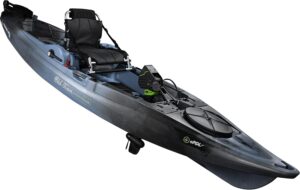
The Old Town Sportsman BigWater ePDL+ 132 is the premium option in this lineup, combining pedal propulsion with power assistance for anglers who want reduced effort during longer trips. Its ePDL+ system allows manual pedaling, power-assisted pedaling, and motorized cruising, providing additional flexibility when covering distance or dealing with current. The 13’2″ kayak offers a 500-pound capacity and shares the BigWater platform’s focus on fishing stability. However, the power-assisted system increases the purchase price, while the battery adds weight and requires charging and maintenance. It is best suited to anglers with larger budgets who prioritize convenience, range, and reduced physical effort.
Specifications
| Spec | Detail |
|---|---|
| Length | 13’2″ |
| Capacity | 500 lbs |
| Hull | Same as standard BigWater PDL 132, plus battery and motor components |
| Drive system | ePDL+ power-assisted pedal, forward/reverse, motorized cruise mode |
| Seat | Same adjustable mesh seat as BigWater PDL |
| Rod holders | 3 flush-mount |
| Warranty | Lifetime limited (hull/deck); 5-year limited (drive) |
| Availability | Amazon.com |
Pros & Cons
| Pros | Cons |
|---|---|
| Power assist meaningfully reduces fatigue on long trips or against current | Battery and motor add weight and require charging/maintenance |
| Same durable hull and lifetime/5-year warranty as the standard BigWater PDL | Significantly more expensive than the standard PDL version |
| Motorized cruise mode covers long transit distances quickly | More electronics onboard means more potential points of failure |
| Flexibility to switch between manual, assisted, and cruise modes | May trigger boat registration requirements in some states |
Buy If:
- You want reduced fatigue on long trips or against current
- You like the flexibility of switching between pedal, power-assist, and cruise modes
- Budget is secondary to capability
Skip If:
- You want to minimize maintenance battery and motor components add upkeep beyond a standard pedal drive
- You’re budget-conscious this is one of the two most expensive kayaks on the list
- You prefer fewer points of potential failure more electronics means more that can go wrong over time
Verdict: The most technologically advanced kayak here. A strong pick for anglers who value range and reduced fatigue and don’t mind paying a premium for it.
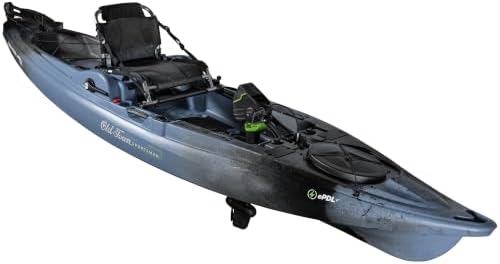
- Patented ePDL+ power assisted pedal drive with 5 speed settings and cruise control
- Includes a compact, powerful 36V 20Ah Li-Ion battery and charger
- Control buttons and polarized sunglasses-friendly screen integrated directly into ePDL+ Drive
Pedal vs. Paddle Kayak: Which Should You Choose?
| Factor | Pedal Kayak | Paddle Kayak |
|---|---|---|
| Hands-free fishing | Yes hands stay on the rod | No must stop paddling to fish |
| Speed over distance | Generally faster, less fatigue | Slower, more physically tiring over long distances |
| Position-holding (wind/current) | Strong many drives offer instant reverse | Difficult requires constant paddle correction |
| Weight | Heavier (65–180+ lbs typical) | Lighter (usually 30–55 lbs) |
| Price | Higher ($1,000–$6,000+) | Lower (often $300–$1,200) |
| Maintenance | Drive system needs rinsing/inspection | Minimal just the hull and paddle |
| Shallow-water use | Some drives need to be raised/removed in very shallow water | No restriction paddle works in any depth |
| Best for | Frequent anglers, long trips, position-critical fishing | Casual paddlers, tight budgets, simplicity-first buyers |
Bottom line: If you fish often and want to maximize time with a line in the water, a pedal kayak is usually worth the added cost and weight. If you kayak occasionally or want the simplest, lightest, cheapest option, a paddle kayak still gets the job done.
Propeller Drive vs. Fin Drive: Which Pedal System Is Better?
| Factor | Propeller Drive (Old Town PDL, Native Propel, Perception Pilot Drive) | Fin Drive (Hobie MirageDrive) |
|---|---|---|
| How it works | Spinning propeller powered by pedal motion | Oscillating fins that “swim” like a fish tail |
| Reverse | Instant pedal backward | Some models instant reverse (MirageDrive 360); classic models require flipping the drive |
| Shallow water performance | Can bog down or need to be raised in very shallow/weedy water | Kick-Up Fins auto-retract on impact, generally better in shallow/obstructed water |
| Serviceability | Generally simpler to service; fewer specialized parts | More proprietary parts; servicing often requires Hobie-specific components |
| Noise | Slightly more mechanical noise in some models | Generally quieter, smoother pedal stroke |
| Efficiency | Strong, especially in open water | Widely regarded as highly efficient per pedal stroke |
| Availability | Sold widely, including on Amazon (Old Town, Native, Perception) | Primarily through Hobie.com and authorized dealers |
Bottom line: Propeller drives tend to be easier to buy, service, and replace parts for. Fin drives (Hobie) are prized for smooth efficiency and shallow-water resilience but come with a higher price and a more limited buying/service network.
Best Pedal Kayaks by Water Type
Saltwater / Coastal Fishing: Prioritize a proven drive with strong reverse control to hold position against tide and current, plus corrosion-resistant hardware. The Old Town BigWater PDL 132, Native Titan Propel 13.5, and Hobie Pro Angler 14 (360) are all built for open, exposed water. Rinse the drive thoroughly with fresh water after every saltwater trip regardless of which kayak you choose.
Large Lakes / Open Bays: Look for a longer hull (13’+) with strong secondary stability for wind and chop. The Old Town BigWater PDL 132, Native Titan Propel 13.5, and Hobie Pro Angler 14 all fit this profile well.
Rivers (Moderate Current): A maneuverable, moderately sized kayak with responsive steering works best the Native Titan Propel 13.5 or Old Town BigWater PDL 132, both with instant reverse, handle current control well. Avoid the lowest-capacity, smallest-hull options if the current is significant.
Small Ponds / Calm Rivers / Beginner Water: A shorter, lighter kayak is easier to maneuver, launch, and transport. The Pelican Catch 110 HDII and Hobie Mirage Passport 10.5 are purpose-built for this kind of water.
Buying Guide: How to Choose the Right Kayak to Fit Your Fishing Needs
1. Match Capacity to Your Real Load Not Just Your Body Weight
Weight capacity on the spec sheet is the maximum the hull can float not the weight it performs well at. As a rule of thumb, plan to use no more than 70–75% of the stated capacity for your angler weight + gear + electronics + catch, so the kayak still sits at an efficient waterline. If you’re 200 lbs and plan to run a fish finder, battery, tackle, and a cooler, you’ll want a kayak rated well above 400 lbs, not one sitting right at that number.
2. Decide Where You’ll Actually Fish
See the “Best Pedal Kayaks by Water Type” section above hull length, stability, and drive type all matter differently depending on whether you’re fishing a farm pond or open coastal water.
3. Understand the Drive System Tradeoffs
See the “Propeller vs. Fin Drive” comparison above for a full breakdown.
4. Factor In Transport and Storage Not Just the Water
Several kayaks on this list weigh 140–180+ lbs fully rigged. If you’re loading solo without a trailer or kayak cart, weight and dimensions matter as much as on-water performance. Measure your garage, shed, or storage space before buying a 13’+ kayak.
5. Compare Total Cost, Not Just Sticker Price
Factor in a paddle (often sold separately on higher-end models), a PFD, an anchor system, and rod holders/electronics mounts if not included. A “budget” kayak with a $600 accessory bill can end up costing more than a better-equipped mid-range model.
6. Check Warranty and Dealer Support in Your Area
Warranty length varies meaningfully across this list from 2-year Hobie coverage to Old Town and Pelican’s lifetime hull warranties. Before buying, search for authorized service centers or dealers near you, especially for drive-system repairs down the line.
7. Prioritize Comfortable, All-Day Fishing: Seat and Room Considerations
Seat quality matters more than most first-time buyers expect. An elevated, adjustable seat with lumbar support (like the Hobie Vantage or Native’s “First Class” seating) makes a noticeable difference on an all-day fishing trip, while a fixed-height seat can get uncomfortable after a few hours. Also consider room for fishing on deck a wider standing platform and a seat that flips out of the way (like the Pelican Catch’s) make it easier to move around, cast from different angles, and land fish without feeling cramped.
Buying Checklist
Before you buy, confirm you’ve covered each of these:
- [ ] Calculated your real-world load (body weight + gear + electronics + catch) against the kayak’s capacity, leaving a buffer
- [ ] Matched the hull length/stability to the water type you’ll fish most (pond, lake, river, or coastal)
- [ ] Chosen a drive type (propeller vs. fin) based on your water conditions and maintenance preference
- [ ] Confirmed you can transport the fully rigged weight solo, with help, or with a cart/trailer
- [ ] Priced out accessories not included in the base price (paddle, PFD, anchor, electronics mounts)
- [ ] Checked warranty length and confirmed a dealer or service center is accessible in your area
- [ ] Verified current price and stock directly on the retailer’s live listing
- [ ] Checked your state’s registration requirements, especially for motor-assisted models
- [ ] Read a handful of recent (not just top) owner reviews on the specific listing you’re considering
Safety Considerations for Pedal Kayak Fishing
Pedal kayaks add convenience, but they also add weight, complexity, and moving parts all of which carry their own safety considerations:
- Always wear a properly fitted PFD (life jacket), even on calm water. A pedal drive doesn’t change your risk of capsizing, and heavier, higher-capacity kayaks can be harder to re-enter if you go overboard.
- Practice a self-rescue/re-entry in calm, shallow water before you rely on it in open water. Pedal kayaks are typically heavier and less nimble to climb back onto than a lightweight paddle kayak.
- Check weather and water conditions before launching, particularly for open water or coastal trips wind and chop affect a pedal kayak’s handling more than they do a small paddle craft in sheltered water.
- Inspect your pedal drive before every outing fins, props, cables, and pins are wear items, and a failure mid-trip can leave you without primary propulsion. Carry a spare paddle as backup on every trip, regardless of drive system.
- File a float plan. Tell someone where you’re launching, your route, and your expected return time.
- Use a leash or tether for your paddle, phone, and key gear. A capsized pedal kayak can be difficult to flip back over solo; losing your backup paddle in the process compounds the problem.
- Know your local regulations. Some states classify pedal kayaks (especially motor-assisted models like the ePDL+) similarly to small vessels, which can trigger registration or safety-equipment requirements check your state’s boating authority before you launch.
Frequently Asked Questions
1. What’s the difference between a pedal kayak and a paddle kayak?
A pedal kayak uses a leg-powered drive system (fins or a propeller) to move through the water, freeing your hands for fishing. A paddle kayak requires you to alternate between paddling and fishing, which limits how much time your line is actually in the water.
2. Are pedal kayaks worth the extra cost over paddle kayaks?
For frequent anglers, most owners find the tradeoff worthwhile more time actively fishing, better position-holding against wind/current, and less fatigue on long trips. Casual or occasional kayakers who prioritize simplicity and lower cost may be better served by a traditional paddle kayak.
3. How much weight capacity do I actually need?
Add your body weight, estimated gear weight (tackle, cooler, electronics, battery), and leave roughly 25–30% of the stated capacity as buffer so the kayak sits at an efficient waterline rather than near its maximum.
4. Can beginners use a pedal kayak, or should I start with a paddle kayak?
Beginners can absolutely start with a pedal kayak models like the Pelican Catch 110 or Perception Pescador Pilot are designed to be simple and forgiving. That said, learning basic paddle strokes is still worth doing, since every pedal kayak should carry a backup paddle.
5. What maintenance does a pedal drive system need?
Rinse the drive thoroughly with fresh water after every use especially after saltwater trips to prevent corrosion. Periodically inspect fins/props, cables, and pins for wear, and lubricate components per the manufacturer’s schedule (intervals vary by brand, so check your specific owner’s manual).
6. Are Hobie kayaks available on Amazon?
Generally, no Hobie sells primarily through its own site and a network of authorized dealers. If you see a Hobie kayak listed on a third-party marketplace, verify it’s from an authorized seller before purchasing, as unauthorized listings can affect warranty coverage.
7. What’s the difference between a propeller drive and a fin drive?
See the full comparison table above. In short: propeller drives are generally simpler to service and more widely available; fin drives (Hobie) are prized for smooth, quiet efficiency and shallow-water resilience but come at a premium.
8. How long do pedal drive systems typically last?
With regular rinsing and basic maintenance, major-brand pedal drives are built to last many seasons, and manufacturers back them with warranties ranging from 2 years (Hobie) to 5 years (Old Town PDL, Perception, Native) depending on brand and component. Individual wear parts like cables, props, or fins may need replacement sooner depending on use and water conditions.
9. Do I need a fishing license or boat registration to use a pedal kayak?
You’ll need whatever fishing license your state requires, same as any other fishing method. Boat registration requirements vary by state and sometimes by kayak type motor-assisted models (like the ePDL+) are more likely to trigger registration requirements than purely human-powered pedal drives. Check your state’s boating/wildlife agency before you launch.
10. Can I fish in saltwater with any of these kayaks?
Yes, but saltwater use increases the importance of maintenance. Rinse the hull, drive, and hardware thoroughly with fresh water after every saltwater trip to prevent corrosion, and check manufacturer guidance some components are more saltwater-resistant than others.
Conclusion
There’s no single “best” pedal drive fishing kayak for every angler the right choice among the many pedal fishing kayaks on the market today depends on where you fish, how much you carry, and how you plan to transport it. If you want one all-around performer with the strongest warranty coverage, the Old Town Sportsman BigWater PDL 132 is a strong starting point. If budget is the priority, the Perception Pescador Pilot 12 and Pelican Catch 110 HDII get you into pedal fishing without a major investment or a heavy kayak to haul around.
For anglers who need maximum capacity or want the most advanced maneuverability, the Hobie Mirage Pro Angler 14 and the power-assisted Old Town ePDL+ 132 sit at the top end of the market expensive kayaks, but ones that deliver genuinely different capability, and just be ready to buy through a dealer rather than Amazon for the Hobie models.
Whichever you choose from this list of the best pedal-drive fishing kayaks, verify current pricing, capacity, and availability directly with the retailer before buying kayak lineups and pricing change frequently, and the specs above reflect the most recent confirmed data at time of publishing.